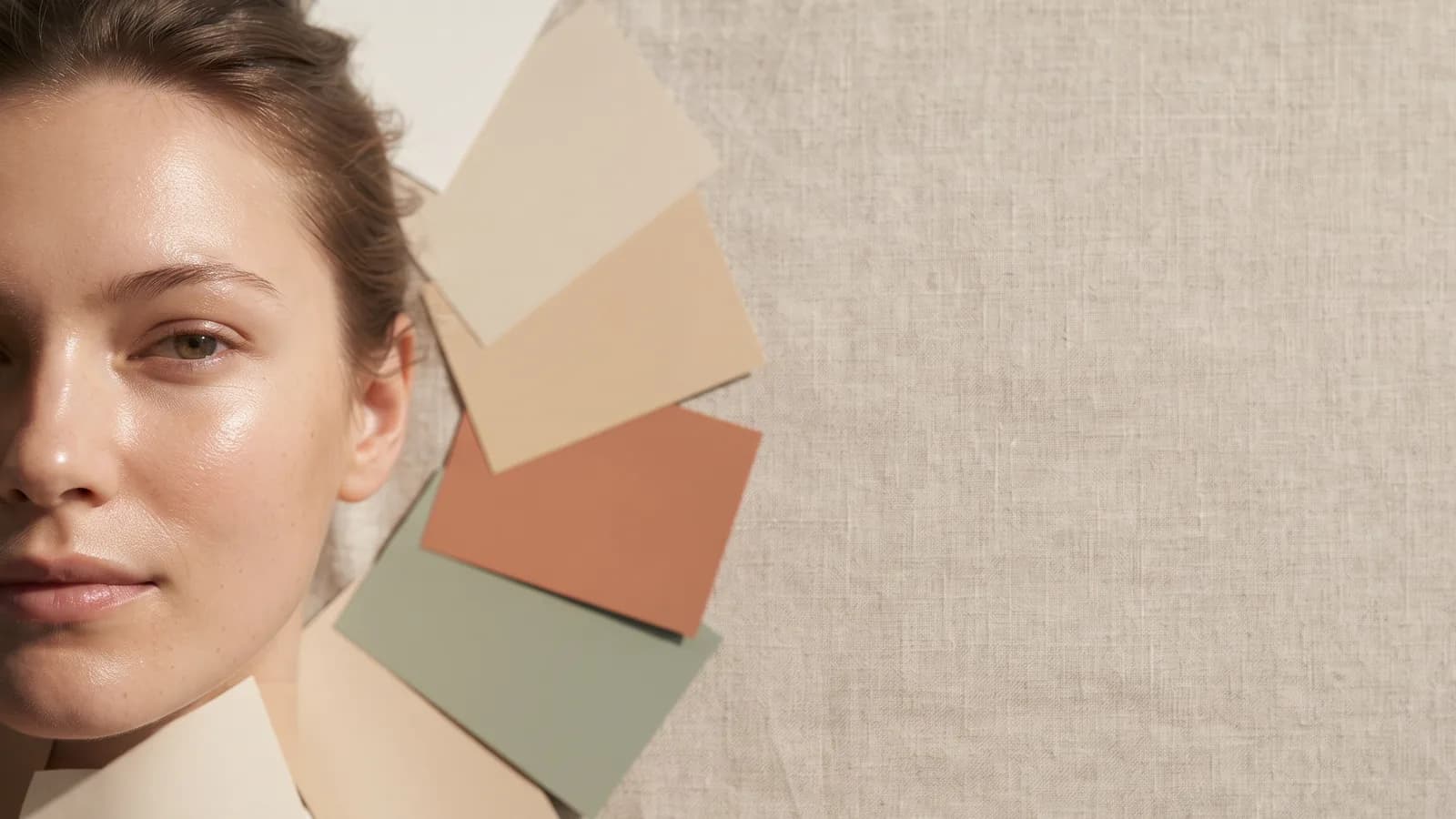
Colour analysis promises something disarmingly simple: that there is a set of colours which make you look well, and another set that quietly work against you. Strip away the seasonal branding and the promise rests on real perceptual science — plus a fair amount of mid-century styling folklore. This is the honest version.
What colour analysis actually is
At its core, colour analysis matches the colours you wear to the colours you are — the pigments in your skin, the depth of your hair, the contrast between them. Done well it is less a book of rules than a way to reduce the visual work your face does to look healthy and awake.
A short history: from Itten to the twelve seasons
The idea traces to Johannes Itten, a painter at the Bauhaus, who noticed that students did their most harmonious work in the colours that suited their own colouring, and grouped these into four families he named after the seasons. In 1940s America the designer Suzanne Caygill built this into a full styling method. It reached the mainstream in 1980, when Carole Jackson’s Color Me Beautiful sold more than seven million copies and put ‘winter’ and ‘summer’ into everyday language. Later practitioners split the four seasons into twelve sub-types to catch the in-between cases.
The three dimensions of every colour
Modern colour theory describes any colour by three properties — the vocabulary comes from the Munsell system:
- Hue — the family: red, blue, green.
- Value — how light or dark it is.
- Chroma — how saturated or muted it is.
Most ‘what season am I’ confusion dissolves once you separate these. Two people can suit the same hue yet need very different values.
Undertone is biology, not fashion
Your undertone is not a trend; it is the sum of three pigments: melanin (brown), haemoglobin (red, from blood) and carotenoids (yellow-orange, largely from diet). Work by Ian Stephen, David Perrett and colleagues shows that observers read health and vitality straight from the balance of these — skin with more carotenoid yellowness and oxygenated redness is judged healthier across cultures. Wear a colour that fights that balance and your face pays for it.
Contrast often matters more than the season
The relationship between your skin, hair and eyes — your natural contrast level — frequently decides whether an outfit lifts your face or flattens it, independent of hue. A high-contrast person swamped in soft pastels can look washed out; a low-contrast person in stark black-and-white can look overpowered.
What has evidence — and what is folk styling
Here is the honest split. The perceptual core is well supported: skin pigmentation is real, contrast is real, and the brain genuinely reads health and attractiveness from facial colour. The system around it — rigid four- or twelve-season boxes — is a styling convention, not a clinical result; no large randomised trials show that anyone belongs to exactly one of twelve groups. That does not make it useless. It makes it a heuristic, best held loosely.
What a rigorous reading looks like
A trustworthy analysis controls the one variable that ruins most amateur attempts: light. Colours should be judged in neutral daylight, against a white field, with fabric draped near the face so you compare like with like. This is exactly the part a camera and a consistent algorithm can make objective — reading your undertone, contrast and palette from a few photos, without the guesswork of a phone screen under warm bulbs.
References
- Stephen, I. D., Coetzee, V. A., & Perrett, D. I. (2011). Carotenoid and melanin pigment coloration affect perceived human health. Evolution and Human Behavior, 32(3), 216–227. DOI
- Stephen, I. D., Law Smith, M. J., Stirrat, M. R., & Perrett, D. I. (2009). Facial skin coloration affects perceived health of human faces. Int. J. Primatology, 30, 845–857. DOI
- Palmer, S. E., & Schloss, K. B. (2010). An ecological valence theory of human color preference. PNAS, 107(19), 8877–8882. DOI