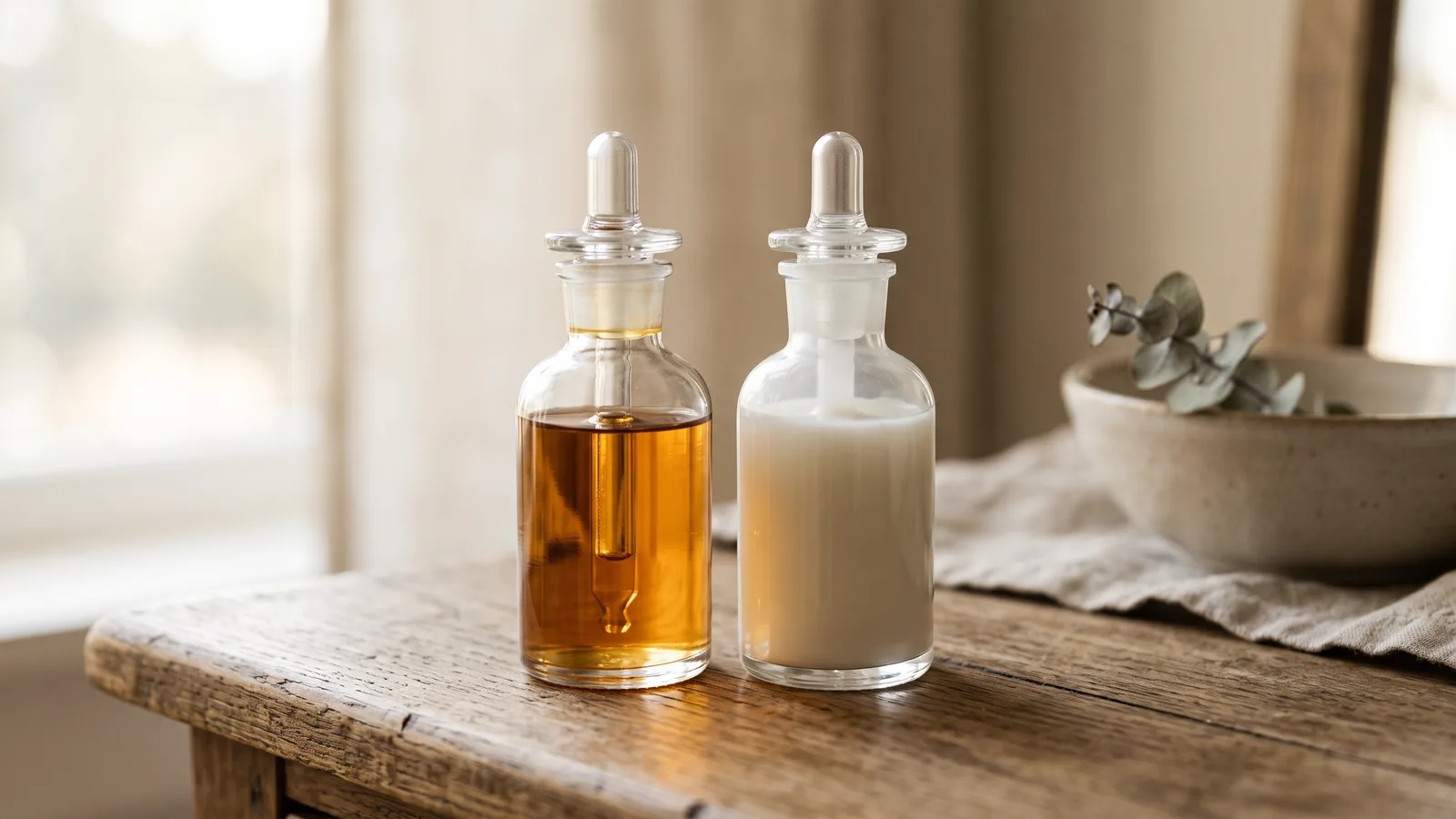
You're standing in front of the anti-ageing shelf, looking at the same thing as always — dozens of serums, each promising that this time something will really change. Past 30, that promise gets personal: the first faint lines around your eyes, skin a little less bouncy than it was five years ago. Two ingredients stand out from the crowd — retinol and peptides. Both have devoted fans, both have research behind them. Just not the same research, and not the same weight of it. Here's what the data actually backs, before you spend on another bottle.
What happens to your skin after 30
Type I and III collagen make up most of the structure of your dermis, and their production slows with age — a well-documented mechanism, not a marketing scare tactic. A study comparing sun-protected skin in younger (18–29) and older (80+) adults found procollagen production dropped by 68–75%. With age, fibroblasts simply make less new collagen and respond more slowly to micro-damage. On top of that, the enzymes that break down existing collagen get more active. The effect isn't visible right away — it builds up over years. That's why 30, not 50, is the sensible moment to act early, before the changes show up to the naked eye.
Retinoids: how they work and where to start
Once retinoids penetrate the skin, they convert into retinoic acid. That's the form that binds RAR nuclear receptors in fibroblasts and keratinocytes (Gericke et al., 2013), switching on the genes behind procollagen production. In a study on naturally aged skin, retinol raised type I procollagen production within 24 weeks — significantly more than the vehicle alone (Kafi et al., 2007).
Not every retinoid works with the same strength. Skin converts it into retinoic acid in stages: retinyl ester → retinol → retinal → retinoic acid, the prescription form known as tretinoin. Each conversion step costs some potency — the closer a form sits to retinoic acid, the faster and stronger it works, but the more it irritates too. A 1997 penetration study found retinal works harder than retinol at the same concentration, while staying gentler than tretinoin.
Where to start? Retinol 0.2% is a safe entry point if you've never used a retinoid before. A study comparing 0.3% and 0.5% — 37 women, 12 weeks — found comparable results at both strengths, but 0.5% brought significantly more irritation. 0.3% is a sensible target, not the highest concentration you can find. Above that, you're into retinol 0.5% or 1% territory, meant for skin that's already adapted.
Retinal is the middle step for a stronger effect without a prescription. In a study on 56 women, retinal 0.1% produced a significant reduction in forehead wrinkles and a 45% increase in skin density after 24 weeks; at 0.05%, wrinkles didn't improve significantly (Deda et al., 2026). Retinal 0.2% sits above the concentration that was actually studied, so ease into it with extra care.
Retinization, step by step
Easing a retinoid into your routine has a name — retinization. Start once or twice a week for the first two weeks, then every other night. Skin usually reaches its target frequency, often nightly, after 4–8 weeks, sometimes 12. The first bout of irritation — dry, flaking skin — is adaptation, not damage, though if it stings badly, step back a level. The "sandwich" method helps: moisturiser, then retinoid, then another thin layer of moisturiser on top. A rich barrier cream in that role saves you weeks of flaking. Thin, reactive skin absorbs more retinoid, so a lower starting strength isn't a nicety for it — it's the baseline.
Retinoids don't make your skin sun-sensitive in any direct sense — that's a myth — but they thin the stratum corneum, so UV does more damage more easily. Morning SPF isn't optional alongside them, whatever the season.
Peptides: what the research actually says
Peptides are playing a different, much younger league of evidence — far less studied than retinoids. You'll mostly find three types in jars. Signal peptides (like palmitoyl pentapeptide-4, or Matrixyl) are meant to "tell" fibroblasts to produce collagen. Copper peptides (GHK-Cu) pair copper with a short amino acid chain. Neurotransmitter-affecting peptides (acetyl hexapeptide-8, or Argireline) get marketed as "Botox in a jar."
That particular mechanism doesn't hold up under scrutiny. A 2025 review found that Argireline penetrates the stratum corneum poorly — in vitro penetration ranges from 0.22% to 30%, depending on the formula. No in vivo study has confirmed the muscle-relaxing effect the whole promise rests on.
The largest available review of GHK-Cu was written by a researcher who also holds patents on the ingredient. Worth keeping in mind next time you read an enthusiastic claim about "gene-level regeneration" — treat it with some scepticism.
The most reliable overall picture comes from a 2026 systematic review and meta-analysis. Of the 19 clinical trials on anti-ageing peptides it covered, only 2 looked at topical use — the rest were oral supplements. The topical effect on skin turned out smaller and not statistically significant. Peptides most likely do something — but next to well-established retinoids, the evidence for that is still early.
When peptides make sense
Peptides win where retinol loses. Very sensitive, reactive skin, rosacea, or skin that simply doesn't tolerate irritation won't report the flaking or stinging that shows up regularly with retinoids in clinical trials. The same goes for pregnancy and breastfeeding (more on that below), and for anyone whose retinoid is already doing its job and wants to add something gentle rather than double up on irritation. A multi-peptide serum works well as a retinoid's companion — it supports the skin barrier while retinol keeps doing the heavy lifting.
How to combine retinol and peptides
These two don't rule each other out in one routine. Most skin handles retinol at night and peptides in the morning just fine, or both at night with ten to fifteen minutes between layers. There's one exception: The Ordinary, which makes a copper-peptide serum, explicitly advises against combining it with a retinoid in the same application — the copper complex can lose stability. If you're using Multi-Peptide + Copper Peptides, give it its own slot in the day. Other, copper-free peptides share a routine with retinol without any issue.
When to stop retinoids, and when to see a dermatologist
Stop retinoids — including over-the-counter ones — during pregnancy and while breastfeeding. Most dermatologists and the American College of Obstetricians and Gynecologists list topical retinoids among the ingredients advised against as a precaution. That said, the evidence of harm for skin-applied forms is weaker than for oral vitamin A. Talk to the doctor managing your pregnancy before you settle on a routine — that's the only safe path. Cosmetic peptides have no documented contraindication in pregnancy, but there's no dedicated safety research on them either — treat them as probably neutral, not as a guarantee.
Cystic acne, deep painful breakouts, or acne scarring are a signal to put DIY skincare aside and book a dermatology appointment. Retinol and peptides look after how your skin looks — inflammation is a doctor's job.
The verdict for 30+
If you're building a routine from scratch, start with a retinoid. It has decades of clinical research behind it, a confirmed mechanism, and a predictable effect on collagen. Add peptides as support — they ease irritation and earn their place on the nights your skin takes off from retinol. On their own, they can't yet carry the role of your main active; the evidence doesn't support that. Start low, go slow, and don't skip your morning SPF.
Pick one well-matched serum, not five at once — and give your skin a few weeks to show you what actually works.
References
- Kafi R, Kwak HS, Schumacher WE, et al. „Improvement of Naturally Aged Skin With Vitamin A (Retinol)." Archives of Dermatology. 2007;143(5):606-612. DOI: 10.1001/archderm.143.5.606 source
- Varani J, Dame MK, Rittie L, et al. „Decreased Collagen Production in Chronologically Aged Skin." American Journal of Pathology. 2006;168(6):1861-1868. DOI: 10.2353/ajpath.2006.051302 source
- Duell EA, Kang S, Voorhees JJ. „Unoccluded Retinol Penetrates Human Skin In Vivo More Effectively Than Unoccluded Retinyl Palmitate or Retinoic Acid." Journal of Investigative Dermatology. 1997;109(3):301-305. DOI: 10.1111/1523-1747.ep12335788 source
- Zasada M, Budzisz E, Erkiert-Polguj A. „A Clinical Anti-Ageing Comparative Study of 0.3 and 0.5% Retinol Serums." Skin Pharmacology and Physiology. 2020;33(2):102-116. DOI: 10.1159/000508168 source
- Deda A, Odrzywołek W, Lebiedowska A, et al. „Comparative Evaluation of Topical Stabilized Retinaldehyde 0.1% vs. 0.05% on Skin Biophysical and Biomechanical Parameters." Skin Research and Technology. 2026;32(2):e70326. DOI: 10.1111/srt.70326 source
- Nukaly HY, Halawani IR, Irtaza HM, et al. „Oral and Topical Peptides for Skin Aging: Systematic Review and Meta-Analysis of Randomized Controlled Trials." Frontiers in Medicine. 2026. DOI: 10.3389/fmed.2026.1618306 source
- Zdrada-Nowak A, et al. „Acetyl Hexapeptide-8 in Cosmeceuticals - A Review of Skin Permeability and Efficacy." International Journal of Molecular Sciences. 2025;26(12):5722. DOI: 10.3390/ijms26125722 source
- Gericke J, Ittensohn J, Mihály J, et al. „Regulation of Retinoid-Mediated Signaling Involved in Skin Homeostasis by RAR and RXR Agonists/Antagonists in Mouse Skin." PLoS ONE. 2013;8(4):e62643. DOI: 10.1371/journal.pone.0062643 source