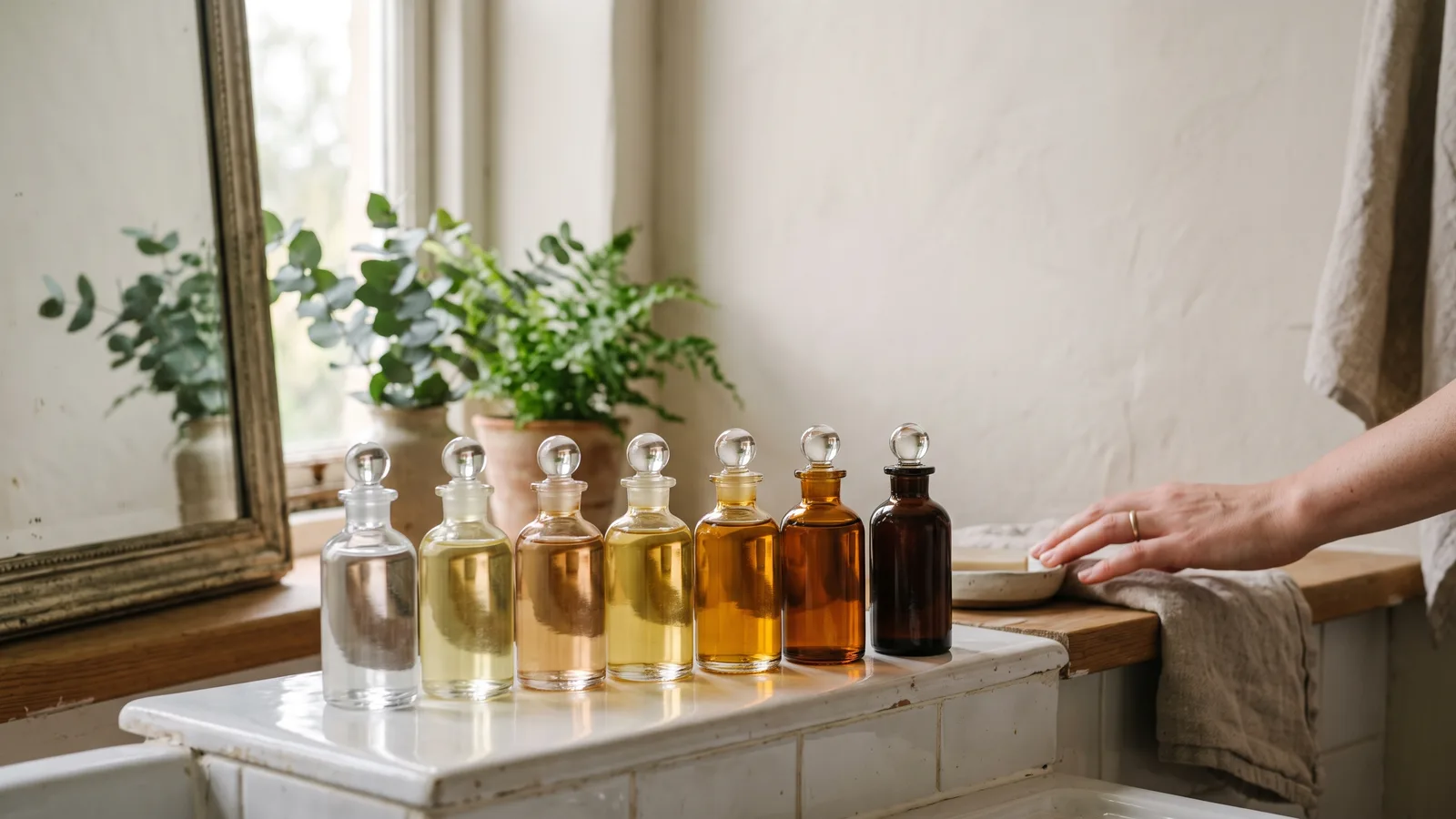
You reach for the serum you bought three months ago. The liquid that was supposed to be clear as water is now the colour of honey, and the smell has shifted — more metallic than it used to be. You paid for an active ingredient. What's left is money that's oxidized.
Shelf time is only part of the story. More often, the real culprit is the form of vitamin C you picked before you knew the differences between them.
What vitamin C actually does
Vitamin C has two well-documented effects on skin. First: it prompts fibroblasts to produce collagen. In a classic 1981 study, ascorbate increased collagen synthesis in cultured human fibroblasts roughly eightfold, without affecting other proteins (Murad et al., PNAS 1981). That's an in vitro study — a lab mechanism, not a guarantee of results on your face in a week. But the mechanism itself is real, and it's been confirmed repeatedly since.
The second effect is photoprotection. In 2005, Sheldon Pinnell's team added ferulic acid to a solution of 15% vitamin C and 1% vitamin E. The result: UV protection rose from fourfold to eightfold, measured by the number of damaged skin cells (Lin et al., Journal of Investigative Dermatology 2005). Think of it as backup for your SPF, not a replacement — it neutralizes the free radicals that slip past the filter, so it works at a different stage than sun protection does.
LAA: the evidence king, and its quirks
L-ascorbic acid (LAA) is the most studied form of vitamin C — and the most demanding. To penetrate skin, the formula needs a pH below 3.5. Above that threshold, the molecule is ionized and can't cross the stratum corneum (Pinnell et al., Dermatologic Surgery 2001). Concentration has a ceiling too: absorption climbs up to 20%, then flattens out. A higher percentage doesn't buy you more effect, just more risk of irritation.
That low pH comes at a price. A brief, passing tingle after application is a normal reaction, not a warning sign — it comes from the gap between the serum's pH (2.5–3.5) and your skin's (4.5–5.5). But if the stinging lasts more than two or three minutes, or gets worse with each use, that's a sign the concentration is too high for your skin.
LAA is also chemically unstable. It oxidizes on exposure to light and oxygen and loses its activity — more on that in the packaging section below.
Derivatives: more stable, gentler, but not always as strong
Not all vitamin C derivatives work equally well. Some don't reach the dermis in sufficient amounts; others don't convert into the active form of vitamin C once they're in the skin (Telang, Indian Dermatology Online Journal 2013). That lines up with Pinnell's 2001 finding: magnesium ascorbyl phosphate (MAP), ascorbyl palmitate, and dehydroascorbic acid failed to raise pure LAA levels in test subjects' skin. The conversion that a good chunk of derivative marketing leans on simply didn't happen in that study.
But derivatives have their own mechanism of action, and their own evidence, independent of any conversion to LAA. Sodium ascorbyl phosphate (SAP) was compared head-to-head with LAA, both at 5%. Both forms produced similar improvements in wrinkle depth and skin elasticity — the difference wasn't statistically significant (comparative study, Journal of Cosmetic Dermatology 2021). MAP has a reputation as a stable, gentle form, but the evidence for its conversion to active LAA is thinner than SAP's: solid documentation on formula stability, weaker documentation on mechanism.
THD ascorbate (tetrahexyldecyl ascorbate), an oil-soluble form, is sometimes marketed as inherently stable. A recent mechanistic study tells a different story. Without an added stabilizer, the molecule loses almost all its antioxidant activity within six minutes of oxidative stress (mechanistic study, International Journal of Molecular Sciences 2021). Adding acetyl zingerone as a stabilizer curbed that degradation and restored its effect on collagen production. So the stability of a form depends on the whole formula, not just the INCI name on the label.
Ethylated vitamin C (3-O-ethyl ascorbic acid) shields its hydroxyl group from oxidation with an added ethyl group. It's a well-described chemical mechanism (compound characterization, International Journal of Pharmaceutics: X 2019). Evidence for a specific clinical effect, expressed in numbers, is still thinner than what exists for LAA.
Which form suits you
- Tolerant skin, chasing the maximum documented effect → LAA at 10–20%, ideally in a formula with vitamin E and ferulic acid.
- Sensitive, reactive skin that balks at low pH → SAP or MAP, usually under 10%. Clinical effect solidly confirmed; conversion to LAA less certain.
- Skin used to oil-based formulas, willing to accept that the result depends on the whole recipe → THD ascorbate or the ethylated form.
Packaging: dark glass, and a colour that warns you
LAA has two enemies: light and oxygen. Dark glass — amber or cobalt — blocks most of the radiation that speeds up oxidation. Airless packaging with a vacuum pump limits air contact with every use more effectively than a standard dropper, because the piston pushes product out without letting air back in.
The colour of your serum tells you where it stands. Clear or pale yellow means fresh serum, full strength. A light gold tint means early oxidation — still safe and mostly active, not a reason to toss the bottle. Deep amber or orange signals serious degradation. Brown, sometimes with a rusty tint, means the active ingredient is mostly spent. Throw the serum out once the colour turns amber or brown and the smell shifts at the same time — to metallic or vinegary. A change in smell is a stronger signal than colour alone.
In practice: when to apply it and what to pair it with
Apply it in the morning, under SPF. Vitamin C doesn't replace sunscreen — it neutralizes the free radicals that get through despite the protection.
You can pair it with niacinamide without worrying. The myth about their incompatibility traces back to a study from decades ago, where pure, powdered forms of both ingredients were heated together at high temperature — conditions that have little to do with a modern, well-formulated product. In today's formulas, the two coexist just fine.
With retinol — yes, but in layers. These two rarely end up in a single formula, because combined they're chemically unstable. The simpler fix: vitamin C in the morning, retinol at night, or alternate them by day. Their different mechanisms complement each other instead of cancelling each other out.
The form of vitamin C you choose should fit your skin, not the label with the highest percentage. Start with a concentration your skin tolerates without protest, and store it so it stays active down to the last drop.
References
- Murad S., Grove D., Lindberg K.A., Reynolds G., Sivarajah A., Pinnell S.R. — "Regulation of collagen synthesis by ascorbic acid", Proceedings of the National Academy of Sciences 1981;78(5):2879–2882. source
- Pinnell S.R., Yang H., Omar M. et al. — "Topical L-Ascorbic Acid: Percutaneous Absorption Studies", Dermatologic Surgery 2001;27(2):137–142. source
- Lin F.H., Lin J.Y., Gupta R.D. et al. — "Ferulic Acid Stabilizes a Solution of Vitamins C and E and Doubles its Photoprotection of Skin", Journal of Investigative Dermatology 2005;125(4):826–832. source
- Telang P.S. — "Vitamin C in dermatology", Indian Dermatology Online Journal 2013;4(2):143–146. source
- Comparative study of SAP vs. LAA in an emulgel formula, Journal of Cosmetic Dermatology 2021;20(1):174–180. source (author list unconfirmed at the time of research — entry listed without names)
- "Tetrahexyldecyl Ascorbate (THDC) Degrades Rapidly under Oxidative Stress but Can Be Stabilized by Acetyl Zingerone to Enhance Collagen Production and Antioxidant Effects", International Journal of Molecular Sciences 2021;22(16):8756. source (author list unconfirmed at the time of research — entry listed without names)
- "3-O-ethyl-l-ascorbic acid: Characterisation and investigation of single solvent systems for delivery to the skin", International Journal of Pharmaceutics: X 2019;1:100025. source