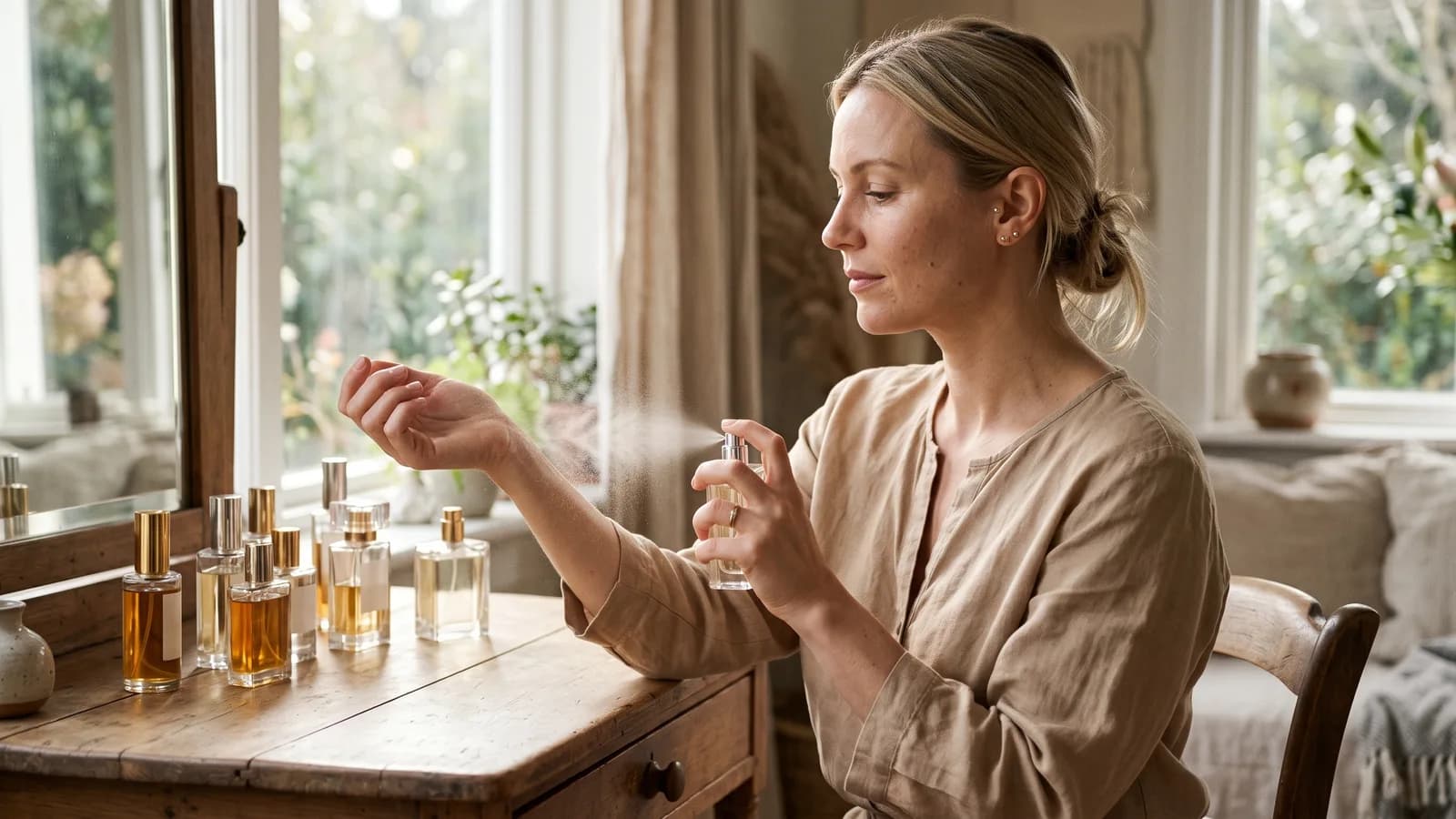
You spritz your wrists with your favourite perfume. You add a second scent from the back shelf onto your neck, and you leave the house smelling like nothing in particular. The notes clash, and instead of depth you get a muddy blur. The problem isn't the perfumes — it's the order: which scent goes underneath, and which goes on top. Layering — deliberately combining two or more fragrances into one composition — is something perfumers have used for decades (Ulta Beauty). Under the label "scent stacking", Gen Z picked up the technique in 2024. Teenage boys in the US spent an average of $110 a year on perfume — 44% more than the year before (Wikipedia: Smellmaxxing). But the rules that actually work are older and simpler than any trend.
What is fragrance layering
Layering means applying two or more fragrances on top of each other or side by side. Together, they combine into a new, third composition. The key is a deliberate choice: which scent will be the foundation, and which one will finish the thought.
Every fragrance has three layers of notes:
- top notes — noticeable in the first few minutes (citrus, herbs),
- heart notes — dominate after a few hours (florals, spices, fruit),
- base notes — linger the longest (musk, wood, amber, vanilla) (Ulta Beauty).
In layering, it's mainly that last layer that matters — it decides whether two fragrances will get along at all.
Base underneath, accent on top
The basic rule of layering is simple: the heavier scent goes underneath, the lighter one on top. The base should be simple and linear — one clear accord, for example pure musk, sandalwood, or vanilla, without an elaborate story of its own. Only on top of it do you build the accent: a more complex fragrance with a distinct character that brings whatever the base is missing.
Vanilla works as an almost universal base — it pairs well with both floral and woody accents. Tobacco fragrances grow best on honey, tonka bean, or oud (Potocka Perfumery). A model example of a simple, almost single-ingredient base is Molecule 01 by Escentric Molecules — the entire composition rests on a single molecule, iso e super, with a woody-amber, velvety character (Wikipedia: Iso E Super).
A shared note as the bridge between fragrances
Bernadette Lim, a Filipino perfumer and founder of the brand BC Fragrances, teaches about fragrance, among other places, for the Fragrance Foundation in New York. She recommends a simple rule: look for two fragrances that share one common note (Allure). That shared note acts as a bridge — it links both compositions instead of letting them fight for dominance. She also warns against combining two dominant materials at once, for example two oud-based fragrances.
Many contemporary niche fragrances make this easier on their own — they share the same synthetic base. Iso e super is one of the most common common denominators. It's sometimes mistakenly called a "pheromone", but the "smells like my own skin" effect is a matter of olfactory perception, not hormones (Wikipedia: Iso E Super). A second frequent bridge is ambroxan — the amber note is now synthesized from sclareol, a component of clary sage oil, not from whales (Wikipedia: Ambroxide).
Concentrations: why the order of EDT, EDP, and extract matters
The concentration of fragrance oil also determines the order. Rough ranges look like this:
- Eau Fraîche — 1–3%
- Eau de Cologne — 2–5%
- Eau de Toilette — 5–15%
- Eau de Parfum — 15–20%
- Extrait de Parfum — 20–40% (WhatScent)
Treat these percentages as a rough guide, not a standard — concentration naming isn't regulated across the industry, so one brand's EDT can be stronger than another brand's EDP. The application rule is simple: the stronger the concentration, the closer to the skin and the earlier in the order. Extract or EDP first as the foundation, then EDT as the lighter layer on top. It's the same logic as "heavier underneath", just measured by concentration (WhatScent).
Fragrance families in a nutshell
The first division of fragrances into families was drawn up in 1949 by Paul Jellinek. The version still in use today was developed in 1992 by Michael Edwards — four main families: floral, woody, fresh, and amber (called oriental until 2021) (Wikipedia: Fragrance wheel). In the expanded version of the wheel, each family splits further — woody, for example, into dry and woody-amber notes, and fresh into citrus and green.
The wheel works like a map of neighbours: families that sit next to each other on the perimeter combine most easily, because they share part of their character. Floral neighbours floral-amber, woody neighbours woody-amber. Families on opposite sides of the wheel — for example fresh citrus and heavy amber — are harder to pair and need a more precise bridge so the effect doesn't come out chaotic.
Where and how to apply the layers
You can use pulse points in two ways — both are fine. First: apply both fragrances in the same spot — wrists, neck, behind the ears — and let them blend directly on the skin into a new whole (Scentbird). Second: separate them — the heavier base on the inner elbows and wrists, the lighter accent behind the ears and on the neck. Then they only mix in the air as you move. The choice depends on what effect you're going for — neither method is "more correct".
Between layers, wait a moment so the previous one has time to settle on the skin — anywhere from about ten seconds to two minutes is enough (Potocka Perfumery). Applying the second fragrance onto a layer that's still wet blurs both compositions.
Moisturised skin holds fragrance longer than dry skin. That's why an unscented body mist or a lotion applied beforehand can make a good base for layering (Ulta Beauty). It's one more reason to take care of your skin barrier every day, not just on special occasions.
For a lighter, seasonal accent, a citrus-green EDT applied on top of a heavier base works well — freshness that doesn't get lost. Before you claim a pairing as your own, test it on your skin. Come back to it after 30–60 minutes, once the top notes have evaporated — only then can you really see how the base and accent play together (Ulta Beauty).
The most common layering mistakes
The biggest mistake is combining two complex fragrances at once — for example two intense bases, or a sweet gourmand with a smoky, incense-heavy accord. Neither one has any way to fade into the background, so both fight for attention and lose together (Potocka Perfumery).
The second common mistake is overdoing the quantity. In layering, you don't add up full doses of both fragrances. As a rough guide, 2–3 spritzes of EDP on the warmer parts of the body and 4–5 spritzes of EDT are enough for both fragrances to be noticeable, without overwhelming (WhatScent).
If you're putting together a small base-and-accent set as a gift, our beauty gift guide by budget has more ideas that don't require buying a third full bottle.
Layering doesn't require rummaging through perfume shops for new bottles right away — often two fragrances you already own are enough. Sign up for the Lucevio newsletter to get more guides on fragrances and matching them to your colour palette.
References
- Fragrance wheel — Wikipedia source
- Iso E Super (Tetramethyl Acetyloctahydronaphthalenes) — Wikipedia source
- Ambroxide — Wikipedia source
- Smellmaxxing — Wikipedia source
- Potocka Perfumery — "Layering perfumy — jak łączyć zapachy i tworzyć kompozycje" source
- Allure Philippines — "How to Master the Art of Fragrance Layering With These Tips" (interview with Bernadette Lim) source
- WhatScent Magazine — "Layering Extrait vs EDP vs EDT: Order & Ratios Guide" source
- Ulta Beauty — "How to Layer Perfume & Fragrances" source
- Scentbird Blog — "How to Layer Fragrances & Create a Signature Scent" source
- Zapachniści.com.pl — "Layering perfum — czyli jak łączyć i mieszać zapachy perfum?" source