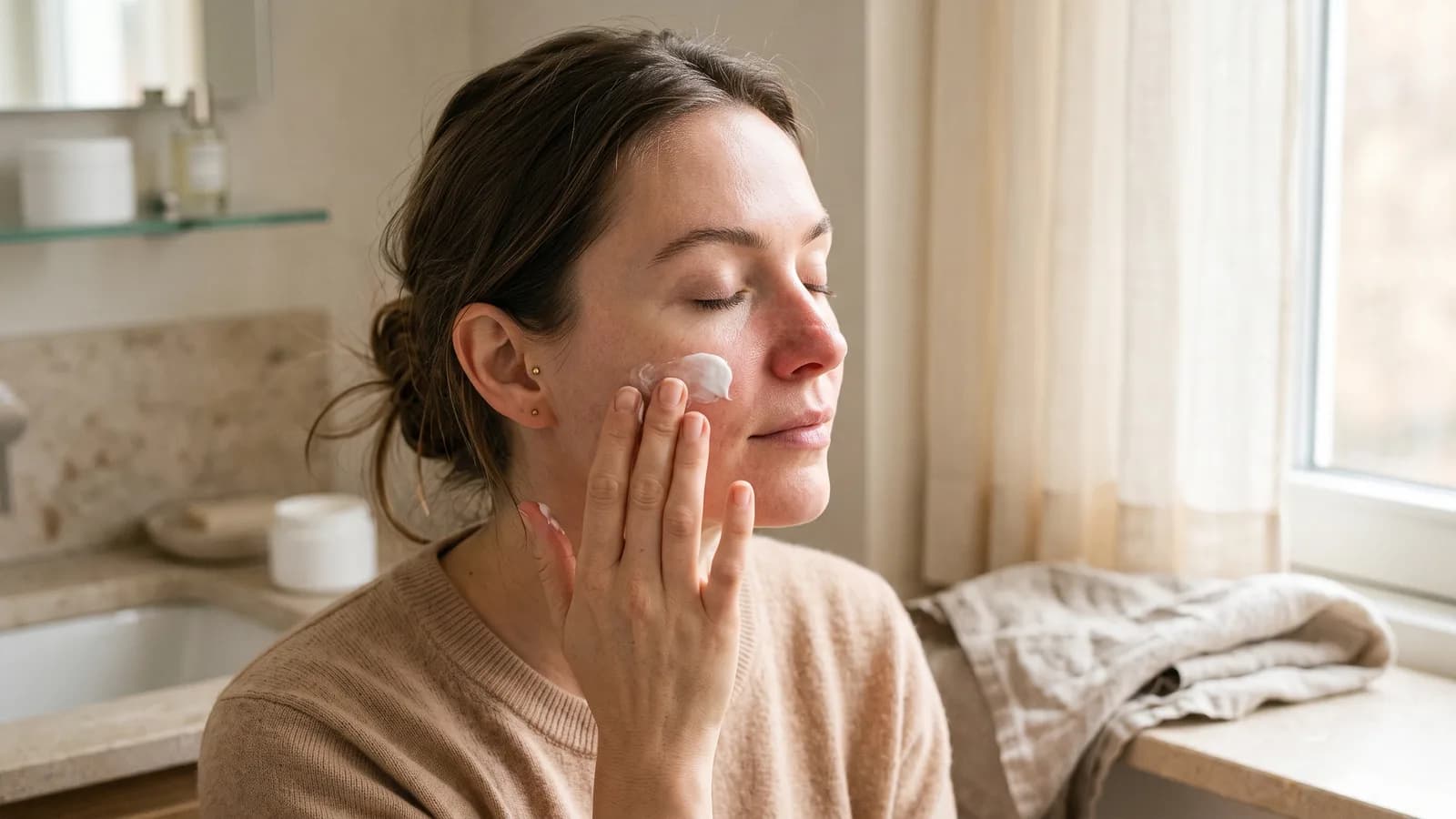
You reach for the cream you've applied without a problem for the past year, and it suddenly stings. The toner that was always gentle now burns like aftershave. Around your nose and cheeks, faint flaking appears, and sometimes just touching your own hands is enough to feel an unpleasant tightness. This isn't a new allergy that came out of nowhere. It's a sign that your skin barrier — the thin layer that holds moisture in and keeps irritants out — has broken down.
What the barrier is: bricks and mortar
Dermatologists describe the outermost layer of skin with the "bricks and mortar" model. Corneocytes — flattened, dead skin cells — are the bricks. Between them sits the mortar: a lipid matrix that binds everything into a sealed whole (Feingold, Journal of Lipid Research 2007). It's this mortar, not the cells themselves, that decides whether skin holds onto moisture or loses it.
That lipid mortar has its own composition: roughly half ceramides, a quarter cholesterol, and the rest essential fatty acids (EFAs), in the 10–15% range (Purnamawati et al., Clinical Medicine & Research 2017). These proportions vary slightly between studies, so treat them as a rough guide, not a pharmacy-precise recipe down to the percentage.
How well that mortar works is measured by TEWL — transepidermal water loss. The tighter the barrier, the less moisture escapes through the epidermis over 24 hours. When the barrier cracks, TEWL rises, and with it the risk of irritation — substances that would normally stay outside penetrate the skin more easily.
The study that showed all three lipids matter
The strongest evidence for how barrier repair actually works comes from a now-classic 1996 experiment. Peter Elias's team applied different mixtures of the three stratum corneum lipids — ceramides, cholesterol, and free fatty acids — to damaged skin (Man et al., Journal of Investigative Dermatology 1996). The result was unambiguous. Only a mixture of all three lipids together let the barrier return to normal. Cholesterol alone, or ceramides alone, without the other components, delayed recovery compared to baseline.
A year later, the same team checked whether the ratio between lipids matters too, this time on mature skin (Zettersten et al., Journal of the American Academy of Dermatology 1997). A mixture with more cholesterol sped up recovery the most. A mixture with more free fatty acids did the opposite — it clearly slowed recovery down.
The skincare industry often sums up these two studies as the "3:1:1 ratio" — ceramides, cholesterol, EFAs. That's shorthand, not a literal quote from either paper. The hard fact reads differently, and it's just as strong: the barrier needs all three lipids at once. An unbalanced formula — say, a cream with ceramides alone, missing the rest of the trio — delays healing instead of speeding it up. So when you're choosing a barrier cream, check the ingredient list, not just the claim on the label.
Healthy skin vs. a damaged barrier
A healthy barrier doesn't announce itself. The products you know behave exactly as they always have, skin stays supple, and redness doesn't show up.
A damaged barrier speaks up more clearly:
- a tight, drawn feeling, even right after washing your face,
- stinging or prickling from products that never bothered you before,
- faint flaking and a rough texture to the touch,
- patchy redness,
- sudden sensitivity to products that have sat in your bathroom for months without a problem.
If these symptoms clear up within a few days of simplifying your routine, you're most likely dealing with temporary barrier damage. It's different when itching is intense and recurring, especially in the creases of your elbows and knees. That can be atopic dermatitis — where a damaged barrier is part of the condition itself, not just an outside effect (Mayo Clinic). Greasy, yellowish scales near the eyebrows or nasolabial folds point instead to seborrheic dermatitis, which has a different underlying cause. If symptoms don't improve despite gentle care, oozing appears, or the itching keeps you up at night — that's the moment to book a dermatologist instead of reaching for another cream.
What most often breaks down the barrier
Usually, several culprits act at once.
The most common one is over-exfoliation — acids or retinol used too often or at too high a concentration. Skin sheds faster than the barrier can rebuild itself, so the lipid coat thins out. If you're just starting out with acids, I've written a separate starter protocol. The same goes for retinol — you'll find the rules for choosing concentration and frequency in the article on retinol and peptides.
In summer, the sun is often to blame. UV radiation weakens the cohesion between cells in the stratum corneum and changes the composition of ceramides, which makes the barrier lose its seal (Biniek et al., PNAS 2012). In winter, low air humidity itself is more often the problem — it also encourages dryness, though that's harder to pin to a single number.
On top of that come water that's too hot and harsh detergents, like sodium lauryl sulfate (SLS) in some cleansing gels. SLS dissolves the skin's natural lipids and disrupts production of the proteins that normally rebuild the barrier. In human studies, returning to normal took several days (Törmä et al., Journal of Investigative Dermatology 2008). Add a vitamin C serum, an exfoliant, and a strong toner to the same routine, and the barrier gets more stimuli than it can handle.
How to repair your barrier step by step
Repair starts with simplifying, not adding more products. For the duration of healing, put acids, retinol, and strong active serums on hold. Stick to gentle cleansing and a barrier cream, plus SPF during the day.
The cleanser itself matters too — the less it foams and the closer it sits to skin's natural pH, the less extra load it puts on the barrier. LRP Toleriane Hydrating Gentle Cleanser combines a soap-free formula with ceramide and niacinamide — a solid choice for this stage.
In a cream, look for the trio from the Elias study section: ceramides together with cholesterol, ideally boosted with linoleic acid from the EFA group, which speeds up recovery and improves hydration (Purnamawati et al. 2017). CeraVe Moisturizing Cream has exactly that composition — three ceramides, cholesterol, and hyaluronic acid in one formula.
Squalane also works well as a light emollient, and shea butter has a soothing effect, while humectants — glycerin and hyaluronic acid — draw water into the stratum corneum (Purnamawati et al. 2017). For very tight, cracked skin, add an occlusive layer at night. Cosmetic petrolatum, even at just 5% concentration, cuts water loss by more than 98% and doesn't clog pores (Czarnowicki et al., Journal of Allergy and Clinical Immunology 2016). CeraVe Healing Ointment combines that occlusion with the same three ceramides.
How long will it take? There's no hard number — it depends on how severe the damage is and how consistent you are with care. Mild irritation usually clears up in a few days; deeper damage can drag on for several weeks. The first signs of improvement — less stinging and a calmer skin tone — are usually visible within the first week.
Before you go back to acids and retinol, give your skin time to regenerate. A simpler routine for a week or two doesn't set your skincare back. It's exactly what makes the actives you reach for later actually work.
References
- Man M.Q., Feingold K.R., Thornfeldt C.R., Elias P.M. — "Optimization of physiological lipid mixtures for barrier repair", Journal of Investigative Dermatology 1996;106(5):1096–1101. DOI: 10.1111/1523-1747.ep12340135 source
- Zettersten E.M., Ghadially R., Feingold K.R., Crumrine D., Elias P.M. — "Optimal ratios of topical stratum corneum lipids improve barrier recovery in chronologically aged skin", Journal of the American Academy of Dermatology 1997;37(3). DOI: 10.1016/s0190-9622(97)70140-3 source
- Feingold K.R. — "Thematic review series: skin lipids. The role of epidermal lipids in cutaneous permeability barrier homeostasis", Journal of Lipid Research 2007;48(12):2531–2546. DOI: 10.1194/jlr.R700013-JLR200 source
- Purnamawati S., Indrastuti N., Danarti R., Saefudin T. — "The Role of Moisturizers in Addressing Various Kinds of Dermatitis: A Review", Clinical Medicine & Research 2017;15(3-4):75–87. DOI: 10.3121/cmr.2017.1363 source
- Törmä H., Lindberg M., Berne B. — "Skin barrier disruption by sodium lauryl sulfate-exposure alters the expressions of involucrin, transglutaminase 1, profilaggrin, and kallikreins during the repair phase in human skin in vivo", Journal of Investigative Dermatology 2008;128(5):1212–1219. DOI: 10.1038/sj.jid.5701170 source
- Biniek K., Levi K., Dauskardt R.H. — "Solar UV radiation reduces the barrier function of human skin", PNAS 2012;109(42):17111–17116. DOI: 10.1073/pnas.1206851109 source
- Czarnowicki T., Malajian D., Khattri S., et al. — "Petrolatum: barrier repair and antimicrobial responses underlying this 'inert' moisturizer", Journal of Allergy and Clinical Immunology 2016;137(4):1091–1102. DOI: 10.1016/j.jaci.2015.08.013 source
- Mayo Clinic — "Atopic dermatitis (eczema) - Symptoms and causes". Accessed: 2026-07-18. source