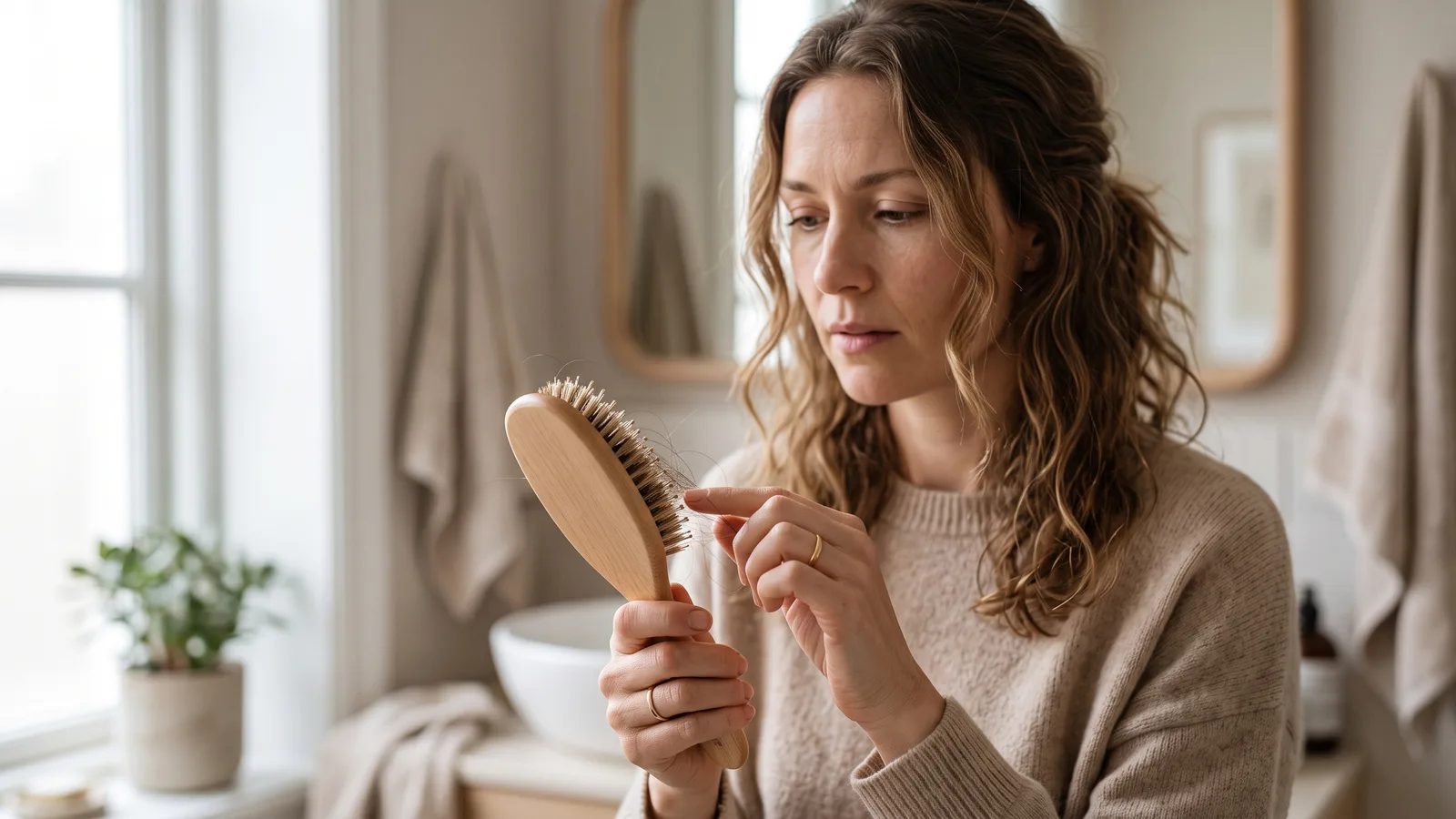
You're seeing more hair on your brush and in the shower drain than a month ago. Before you buy another product from an ad, separate two things. Minoxidil is a drug with real clinical evidence behind it. Caffeine in shampoo or copper peptides in serum have much weaker evidence — and that needs to be said plainly. I check what actually works in over-the-counter trichology, and what just sounds good. I also show the line past which you go to a doctor instead of a pharmacy.
The hair cycle: why it sometimes falls out for no obvious reason
A healthy scalp has around 85% of hairs in the growth phase, anagen — it lasts two to four years. The rest sit in telogen, the shorter resting phase, three to four months (StatPearls, Telogen Effluvium).
Telogen effluvium is a situation where an unusually large share of follicles shift from anagen to telogen all at once — under severe stress, up to 70%, according to some sources. Triggers include fever, serious illness, childbirth, a restrictive diet, a deficiency, or a medication. Hair only starts shedding two to three months after the trigger, which makes it hard to connect cause and effect right away.
That part, at least, is good news: acute telogen effluvium resolves on its own in about 95% of cases. The postpartum version, triggered by the drop in estrogen after pregnancy, usually clears up in 6–12 months without treatment. A doctor will typically reassure the patient and check for an additional cause, such as a thyroid issue.
Minoxidil 2% and 5%: the only OTC drug with strong evidence
Minoxidil is a drug, not a cosmetic. In Poland, you can buy it over the counter in 2% or 5% strength, under brands such as Minovivax, Alopexy, Loxon, or Piloxidil. A pack costs roughly 33–87 zł (doz.pl). It's registered for treating androgenetic alopecia in people aged 18–65: 2% for women and men, 5% mainly for men. The choice of strength and how to use it is a matter for the package leaflet, a pharmacist, or a doctor.
The mechanism isn't hormonal — unlike antiandrogen drugs, minoxidil doesn't block DHT. It opens potassium channels in blood vessels, improves blood flow to the follicle, shortens the resting phase, and extends the hair's growth phase. It's a prodrug: an enzyme in the follicle, sulfotransferase SULT1A1, converts it into its active form. Low activity of this enzyme explains why the drug sometimes doesn't work despite regular use (PMC9326921 review).
In April 2025, the American Academy of Dermatology published updated guidelines on the safe use of topical and oral minoxidil. It's a solid reference point if you want to check the topic at the source (JAAD 2025).
The initial shed: why hair falls out more before it gets thicker
In a 2025 study (49 people, 24 weeks), the 5% group had increased shedding for 4–8 weeks, and the 2% group for 8–12 weeks. Only after that did hair density start to increase. A stronger "shed" correlated with a better treatment response, especially at 5% (Journal of Dermatological Treatment 2025). That's data from a small group — but increased shedding at the start is a documented stage, not automatically a sign of failure. If something worries you, check with a doctor or pharmacist.
The second thing to remember: minoxidil's effect only lasts as long as you keep using it. The drug doesn't cure androgenetic alopecia once and for all. After you stop, the follicles return to their natural cycle. The "recovered" hair falls out gradually, until the scalp returns to its pre-treatment state — usually within 6–12 months (clinical review).
Ketoconazole shampoo: support worth considering
2% ketoconazole shampoo is a cosmetic readily available at pharmacies. The evidence for its benefit is more convincing than for caffeine, though still weaker than for minoxidil. A 2020 systematic review (two animal studies, five in humans, 318 people) showed hair thickening and improvement visible in clinical photos. In one study (150 men), the ratio of hairs in growth phase to resting phase rose from 2.2 to 2.4 with ketoconazole alone, and to 2.6 with finasteride added (Fields et al., Dermatologic Therapy 2020).
The mechanism isn't fully established — some researchers point to anti-inflammatory and anti-seborrheic action, others add a weak antiandrogenic effect. The review's authors say it plainly: this is supportive therapy, not a replacement for treatment. Treat the shampoo as an addition to your routine, not its foundation.
Caffeine: weaker evidence than the marketing suggests
Caffeine in hair shampoos and tonics sounds scientific, but the body of evidence is thin. A 2025 systematic review (Jagiellonian University) covered nine clinical studies on 684 people (Szendzielorz and Śpiewak, Healthcare 2025). The authors rated the quality of evidence as moderate in three studies, low in one, and very low in the remaining five — mainly due to the lack of randomization and control groups. There's a practical problem too: you rinse shampoo out after a minute or two, so caffeine has little time to act.
To be fair: effects in cell studies look promising, but human studies haven't confirmed that yet. Caffeine can be an addition to your routine, but it won't replace minoxidil.
Copper peptides: a promising mechanism, weaker clinical confirmation
Copper peptides (GHK-Cu) in scalp conditioners and serums have stronger mechanistic grounding than clinical. Cell and animal studies show they activate the follicle's shift from resting phase to growth and stimulate hair papilla cells. Three separate studies of one commercial formula from the 1990s showed greater density and less shedding. A large, independent, placebo-controlled study of the peptide alone is still missing, though, and the estimated effect size is smaller than with 5% minoxidil (GHK-Cu evidence review).
The peptide also penetrates intact skin poorly, which is why some protocols pair it with microneedling — which goes beyond ordinary over-the-counter care. A conditioner or serum with copper peptides works well as an addition to your routine, alongside ketoconazole or minoxidil, not as a standalone first-choice therapy. Peptides work in a similar way in skincare after 30.
Iron, ferritin, vitamin D: supplements only work if you're deficient
Iron deficiency and low ferritin are linked to telogen effluvium — meta-analyses confirm this. Studies most often set the deficiency threshold at a ferritin level of 20–30 ng/mL. Some trichologists aim higher, closer to 70 ng/mL, but that's clinical opinion, not a hard consensus (PMC8928181 review). Bottom line: this is a reason to get a blood test and discuss the result with a doctor, not a standalone target to hit through supplementation.
It's similar with vitamin D. A 2024 review shows a high rate of deficiency in people with various types of hair loss. It ranges from about 47% in androgenetic alopecia in men to over 52% in alopecia areata (Frontiers in Nutrition 2024). That's correlation, not proof that supplementation treats shedding. Improvement after correcting the deficiency only shows up after 3–6 months, and it doesn't reverse androgenetic alopecia.
Without a deficiency confirmed by a blood test, supplements have nothing to fix. Before you buy iron or vitamin D "for your hair," get tested first.
When it's not ordinary shedding: signals that mean you see a doctor
Most of the shedding described above can be safely observed and treated on your own. But there are signals where you don't wait — you go to a doctor or trichologist:
- a sudden, smooth, round patch of baldness with no skin changes, sometimes with "exclamation-mark hairs" at the edge — the typical picture of alopecia areata,
- very fast, dramatic thinning,
- loss of eyebrows or eyelashes together with hair loss on the scalp,
- redness, pain, scabs, or oozing blisters on the scalp — this can be scarring alopecia, which irreversibly destroys follicles without prompt intervention,
- shedding along with fatigue, cycle disturbances, sudden weight change, or heart palpitations — this can be a thyroid issue, anemia, or another systemic cause, not a cosmetic one,
- hair loss in a child.
In these situations, no shampoo or supplement can replace a diagnosis — the sooner you see a doctor, the better the chance the follicles can be saved (American Hair Loss Association).
Hair loss rarely has a single cause, and even more rarely a single instant fix. Start with what has evidence behind it — and for more reviews like this, sign up for the Lucevio newsletter.
References
- American Academy of Dermatology / JAAD — "Summation and recommendations for the safe and effective use of topical and oral minoxidil", Journal of the American Academy of Dermatology, April 2025. DOI: 10.1016/j.jaad.2025.04.016 source
- Fields J. et al. — "Topical ketoconazole for the treatment of androgenetic alopecia: A systematic review", Dermatologic Therapy, 2020. DOI: 10.1111/dth.13202 source
- Szendzielorz E., Śpiewak R. — "Caffeine as an Active Ingredient in Cosmetic Preparations Against Hair Loss: A Systematic Review of Available Clinical Evidence", Healthcare, 2025. DOI: 10.3390/healthcare13040395 source
- "Iron Deficiency and Nonscarring Alopecia in Women: Systematic Review and Meta-Analysis". Accessed: 2026-07-19. source
- "Vitamin D deficiency in non-scarring and scarring alopecias: a systematic review and meta-analysis", Frontiers in Nutrition, 2024. Accessed: 2026-07-19. source
- StatPearls (NCBI Bookshelf) — "Telogen Effluvium". Accessed: 2026-07-19. source
- "Sulfotransferase SULT1A1 activity in hair follicle, a prognostic marker of response to minoxidil treatment in patients with androgenetic alopecia: a review". Accessed: 2026-07-19. source
- "Whether the transient hair shedding phase exist after minoxidil treatment and does it predict treatment efficacy? A retrospective study in androgenetic alopecia patients", Journal of Dermatological Treatment, 2025. DOI: 10.1080/09546634.2025.2480739 source
- American Hair Loss Association — "Scarring Alopecia". Accessed: 2026-07-19. source
- doz.pl — legal status and availability of minoxidil in Poland. Accessed: 2026-07-19. source
- gethealthspan.com — evidence review on GHK-Cu and hair growth (an industry source, not a peer-reviewed medical journal). Accessed: 2026-07-19. source
- happyhead.com — "What Happens If You Stop Using Minoxidil" (a secondary review). Accessed: 2026-07-19. source