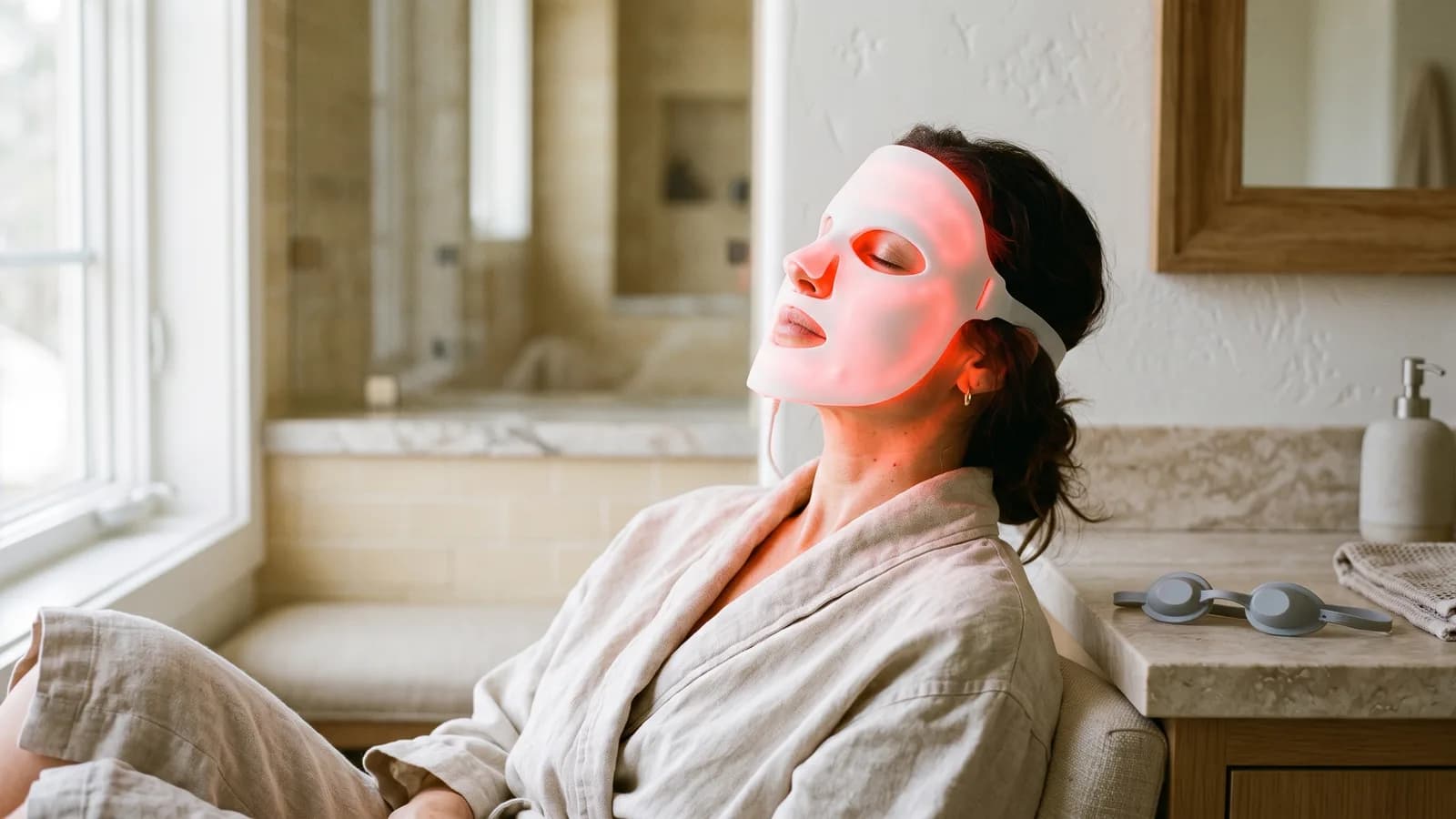
You buy an LED mask because it promises the effect of a professional treatment in your own bathroom. Whether it actually works comes down to three numbers that rarely make it onto the packaging: wavelength, light power, and exposure time. Without them, the manufacturer's claims stay just a promise.
What red light and near-infrared do in the skin
Red light in the 630–660 nm range and near-infrared around 810–850 nm work through photobiomodulation. Photons stimulate cytochrome c oxidase in the mitochondria of skin cells, which is thought to trigger fibroblasts to produce collagen (Koperdowska, Broen, Forum Dermatologicum 2026).
The strongest evidence for this mechanism's effect comes from a randomized, double-blind, sham-controlled trial — 60 participants, 59 completed the program (Medicine 2025). The mask emitted 630 nm and 850 nm, at a maximum of 10 mW/cm² per band. Protocol: 9 minutes a day, 5 times a week for 12 weeks — 60 sessions in total. Under-eye wrinkles improved in 86.2% of the treatment group, versus 16.7% in the control group (p=0.000).
That's a solid result, but not a definitive one. The authors only tracked the effect for 4 weeks after the end of therapy, and some participants may have used other skincare products in parallel that the study didn't control for.
Blue light versus acne bacteria
C. acnes bacteria (formerly P. acnes) produce porphyrins — compounds that, under 407–420 nm light, generate reactive oxygen species and damage the bacterial cell membrane. A 2003 laboratory study showed bacterial viability dropping by as much as 7 orders of magnitude at a dose of 75 J/cm² (Ashkenazi et al., 2003). That's an experiment on a bacterial culture, not on human skin. The result shouldn't make it into an ad without that caveat.
Closer to real-world use is a study of a mask combining 415 nm and 633 nm (Omnilux Clear, an FDA-cleared device). It involved 30 patients aged 14–45: 10 minutes of exposure, 4 times a week for 7 weeks. Inflammatory lesions dropped by an average of 13.07 points, non-inflammatory lesions by 14.73 (p<0.0001 for both). In 86% of participants, acne improved by at least one severity grade (Ablon, J Clin Aesthet Dermatol 2025). The author herself notes the design's weakness: the study was open-label, without a sham-light control group.
Acne is a skin disease, not a cosmetic inconvenience. For mild to moderate lesions, LED light can be a real support — the available studies don't extend beyond that range. Severe or cystic acne is a matter for a dermatologist, not a lamp in your bathroom.
How much evidence do we really have
A 2023 systematic review pooled 31 studies — 15 randomized and 16 observational — and found statistically significant benefits for red and blue light protocols (Ngoc et al., Photodermatology, Photoimmunology & Photomedicine 2023). That sounds convincing, until you check exactly what was tested.
A more recent 2025 review, published in JAMA Dermatology, narrowed the criteria to genuine at-home devices tested specifically for acne. Only 6 studies qualified (Ershadi, Barbieri, 2025). The gap between 31 and 6 shows how little hard data actually covers the equipment you'd buy for your home.
Power and dose: the numbers that decide the effect
A home mask and a device from a professional aesthetics clinic differ above all in power. Koperdowska and Broen (2026) estimate consumer-device irradiance at 6–40 mW/cm² for blue light and 8–80 mW/cm² for red. Professional systems deliver more, in a calibrated, repeatable way. Dermatologist Jesse Pines describes a similar picture in an interview for Forbes: clinical equipment runs at 100+ mW/cm², while many home masks fall in the 20–40 mW/cm² range. Some manufacturers don't publish specs at all (Forbes, 2026).
Even more important is the total dose, or fluence (J/cm²) — power multiplied by time. Home devices typically deliver 1–5 J/cm² per session, while full activation of photobiomodulation in clinical studies requires 20–60 J/cm² (Koperdowska, Broen, 2026). That's probably the single strongest indicator of whether a mask has any chance of working at all.
On top of that comes distance from the skin. With a poorly fitted mask and a gap of just 2 centimeters, a device can lose as much as 90% of its energy before it reaches the tissue (Forbes, 2026). The irradiance stated on the packaging and the amount actually delivered to your skin are often two different numbers.
Retinol and peptides still have a longer track record of evidence for collagen building than most home LED masks — check how to choose the right concentration after 30. A mask can be a good addition to your routine, rarely a replacement for it.
"FDA-cleared" is not the same as clinically tested
Manufacturers love to write "FDA-cleared," and sometimes even incorrectly "FDA approved." Most LED masks sold for acne or wrinkles reach the US FDA through the 510(k) pathway, intended for Class II devices. That's proof of "substantial equivalence" to a device already on the market, not an independent efficacy test at a specific irradiance (Light Tree Ventures, 2026). The term "FDA approved" is simply incorrect here.
That doesn't mean the mask doesn't work. It means the regulatory stamp alone tells you nothing about the power or dose your skin actually gets.
When an LED mask is a gadget, and when it's a tool
The rule is simple: without a stated wavelength and irradiance, you can't calculate the dose, and without the dose, efficacy claims are empty. Even some published clinical studies don't independently measure the irradiance of the device used, so it can be hard to verify even in the scientific literature (Forbes, 2026).
Before you choose a mask, check three things on the product page: the exact wavelength in nanometers, the irradiance in mW/cm², and the length of a single session. That time should match the protocols used in studies — roughly 9–10 minutes, several times a week, over weeks, not days. If this data is missing from the product page, the mask might feel pleasantly warm on your skin, but the collagen effect stays wishful thinking.
Eye safety and the limits of use
The retina has photoreceptors especially sensitive to blue light. Protective goggles are mandatory with this kind of mask. A case has been documented of a 37-year-old woman who used a mask (blue 460–470 nm, red 620–680 nm, NIR 760–900 nm) according to the manufacturer's instructions. She exposed her face for 20 minutes every other day, with her eyes open. The manufacturer didn't disclose the blue light power. After a month she developed photochemical retinopathy — damage to the retinal pigment epithelium and vision disturbances that didn't fully resolve despite treatment (case report, PMC).
Industry rule of thumb: for a device emitting blue light without built-in eye protection, opaque goggles compliant with IEC 62471 are required. Ordinary sunglasses don't provide that protection.
There are also limits that no amount of power will change. For melasma and hyperpigmentation, photobiomodulation currently isn't recommended — the risk of worsening pigmentation is real, especially in darker skin phototypes (Koperdowska, Broen, 2026). The American Academy of Dermatology adds that red light appears safe with short-term use, but the effect requires consistency. That's several sessions a week for 4–6 months, ideally after talking to a dermatologist (Harvard Health).
Want to check whether the mask you're eyeing even gives you the data you need to judge it? Go back to the three numbers from this article — wavelength, irradiance, session time — and compare them with the product page before you add anything to your cart.
References
- Koperdowska J.M., Broen J.A. — "Light-emitting diode photobiomodulation in dermatology: From professional systems to consumer devices — mechanisms, efficacy and safety", Forum Dermatologicum 2026;12. DOI: 10.5603/fd.111321. Accessed: 2026-07-19. source
- Randomized, double-blind, sham-controlled trial of a home LED (630 nm) / IRED (850 nm) mask for periorbital wrinkles, 60 participants, Medicine 2025. DOI: 10.1097/MD.0000000000041596. Accessed: 2026-07-19. source
- Ablon G. — "Evaluating the Efficacy and Safety of Phototherapy", Journal of Clinical and Aesthetic Dermatology 2025;18(10):25–32. Accessed: 2026-07-19. source
- Ashkenazi H. et al. — "Eradication of Propionibacterium acnes by its endogenic porphyrins after illumination with high intensity blue light", FEMS Immunology & Medical Microbiology 2003. DOI: 10.1111/j.1574-695X.2003.tb00644.x. Accessed: 2026-07-19. source
- Ngoc L.T.N. et al., Photodermatology, Photoimmunology & Photomedicine 2023. DOI: 10.1111/phpp.12841. Accessed: 2026-07-19. source
- Ershadi S., Barbieri J.S. — "At-Home LED Devices for the Treatment of Acne Vulgaris: A Systematic Review and Meta-Analysis", JAMA Dermatology 2025. DOI: 10.1001/jamadermatol.2025.0019. Accessed: 2026-07-19. source
- Case report of photochemical retinopathy after using an LED mask (blue/red/NIR) with eyes open. Accessed: 2026-07-19. source
- Harvard Health — "Red light therapy for skin care". Accessed: 2026-07-19. source
- Pines J., Forbes — "Do Those Friday The 13th-Like LED Face Masks Work? A Doctor Explains", 2026-05-28. Accessed: 2026-07-19. source
- Light Tree Ventures — "Understanding FDA Clearance for Light Therapy Devices". Accessed: 2026-07-19. source