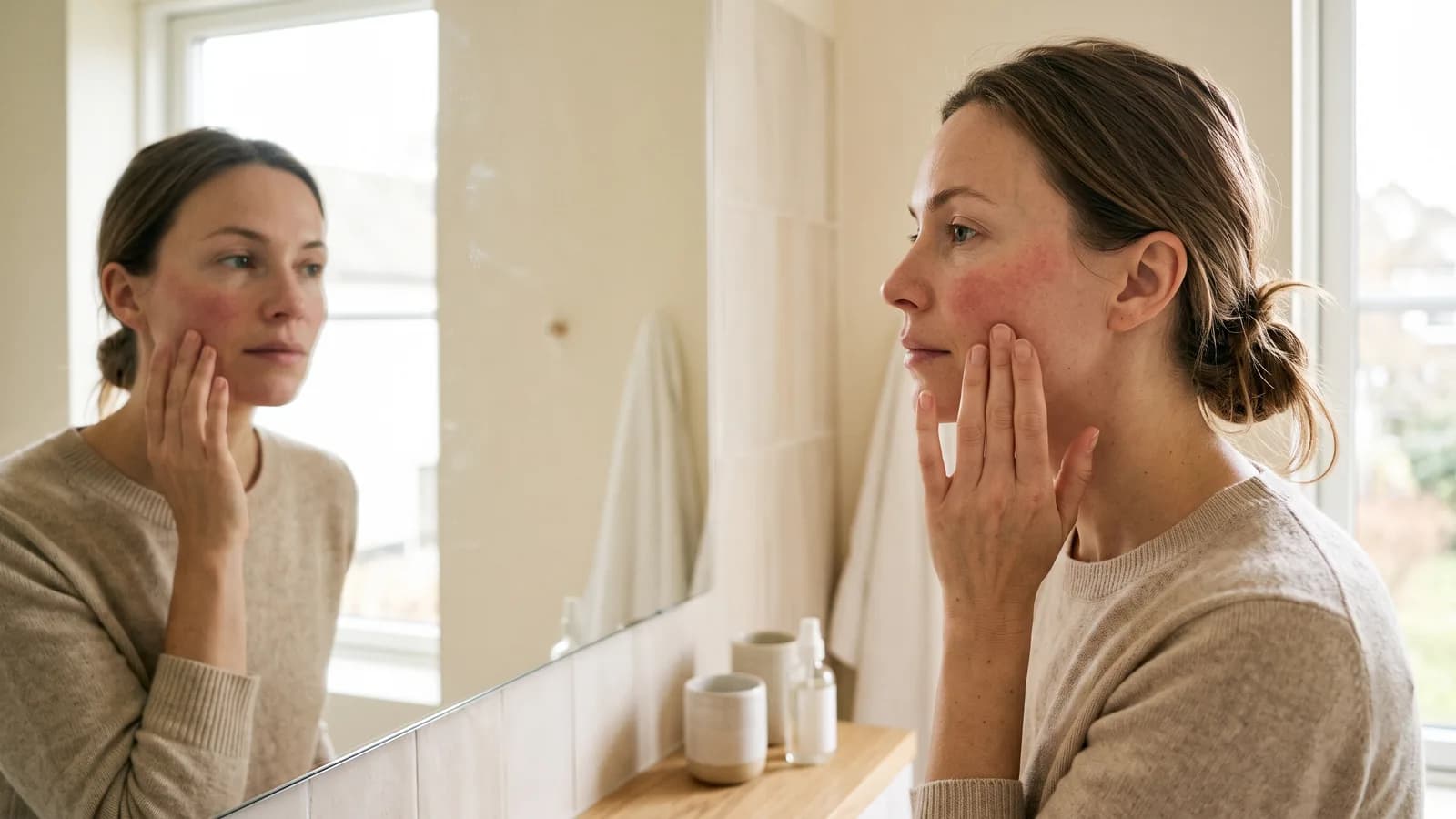
You drink a cup of hot tea, and within minutes two red patches show up on your cheeks. You come in from the cold to a warm room, and your face is burning before you've even unwound your scarf. A new cream, marketed as "gentle for everyone," leaves you with stinging and a web of visible capillaries. It feels like your skin reacts to everything. That's physiology, not oversensitivity: the blood vessels in your skin dilate more easily than most people's. You can work with that, once you know what calms it down and what sets it off.
Redness-prone skin vs. rosacea: where the line sits
This distinction matters more than any ingredient in this article. Sensitive skin reacts to a specific trigger — a new product, cold air, spicy food — and settles back down once the trigger is gone. Rosacea works differently. It's a chronic inflammatory skin condition, mostly across the center of the face, and without treatment it tends to progress. The redness doesn't fully clear between flare-ups, and it sometimes forms a butterfly-shaped pattern. Visible blood vessels, papules, and pustules that don't respond to acne treatment can join in (Golden State Dermatology). Dedicated rosacea skincare exists for a reason: the condition involves chronic vascular inflammation and an altered skin microbiome — this runs deeper than sensitivity alone (Nowicka et al., Journal of Clinical Medicine 2022).
The American Academy of Dermatology lists the full range of rosacea symptoms:
- easy flushing with a feeling of warmth,
- persistent redness that lasts for weeks,
- papules and pustules,
- visible blood vessels,
- eye involvement in up to half of patients,
- thickened skin on the nose,
- stinging triggered by water alone,
- dryness and itching (AAD).
See a dermatologist when:
- redness on your cheeks, nose, chin, or forehead is getting worse and won't go away;
- you notice fine visible vessels that would qualify for laser treatment;
- papules or pustules appear without blackheads, and don't respond to acne treatment;
- your eyes water, sting, or feel gritty — a possible sign of ocular rosacea, which can damage the cornea if left untreated (NRS).
Recognize yourself in any of these? Then the next step is a dermatologist's office, not another jar of cream. This article covers skincare for reactive skin. Treating rosacea is a separate conversation.
What triggers redness: blood vessels and the factors that make it worse
What actually dilates these vessels? The National Rosacea Society collected data on what most often triggers flushing in people with rosacea:
- sun exposure — 81% of respondents,
- emotional stress — 79%,
- heat — 75%,
- wind — 57%,
- physical exercise — 56%,
- alcohol — 52%,
- hot baths and showers — 51%,
- cold weather — 46%,
- spicy food — 45% (NRS, 2002 survey).
In a separate survey of 3151 people with rosacea, nearly half of the women reported wine as a trigger (NRS, 1999 survey).
These triggers fall into four groups: temperature (heat, hot showers, sauna, cold), sun, emotion combined with physical exertion, and diet. Sun exposure has the strongest effect — more on that in the SPF section below. You don't need to cut coffee and wine out of your life for this. Instead, notice what makes your skin flush the most, and start cutting back there.
Ingredients better left out of your routine
The National Rosacea Society asked more than a thousand people with rosacea which cosmetic ingredients most often triggered stinging. Alcohol in the formula topped the list, flagged by 66% of respondents. Next came witch hazel — 30%, fragrance — nearly 30%, menthol — 21%, peppermint — 14%, and eucalyptus oil — 13% (NRS, 1997 survey). The cooling sensation from menthol or camphor is a nerve signal, not an actual drop in skin temperature — which is why it can stimulate blood vessels rather than calm them. Clinical guidelines add foaming cleansers, drying formulas, and physical scrubs to this list. Skip strong facial massage too — gentle lymphatic drainage is the only kind that's fine here (Nowicka et al. 2022). A soap-free, detergent-free cleansing gel cleans gently without stripping skin .
Strong acids and high-strength retinol are more of a case-by-case call. Low-pH acids tend to irritate redness-prone skin more often than retinoids do. Plain retinol is usually easier to tolerate than tretinoin, though it can still sting for some people. Start at a low concentration and watch how your skin responds, rather than following a rigid schedule you found online (Medical News Today). High concentrations of pure vitamin C (L-ascorbic acid) can sting on a compromised barrier — that's a practical observation, though, not a dedicated clinical study in this group. Treat it as a cue to patch-test on a small area rather than a hard rule.
Ingredients that calm and strengthen blood vessels
Niacinamide has documented anti-inflammatory effects on a damaged skin barrier — studies describe the same effect in rosacea, acne, and psoriasis (Journal of the American Academy of Dermatology). I cover dosing and combining this ingredient separately, in the article on niacinamide .
Azelaic acid deserves a word of caution on its own. A 15% formula proved effective for treating inflammatory rosacea in a multicenter trial (Journal of Cosmetic Dermatology 2021). A systematic review confirms its anti-inflammatory effect in acne and hyperpigmentation too (Journal of Cosmetic Dermatology 2023). Those high concentrations — 15–20%, as in Finacea or Skinoren — are a prescription medication in many countries, not a drugstore cosmetic. Lower concentrations, up to around 10%, show up in over-the-counter products and can even out skin tone. Curing rosacea, though, sits outside any cosmetic's job description — that's the dermatologist's call.
Centella asiatica extract (madecassoside) has confirmed anti-inflammatory effects and supports barrier repair, partly by stimulating collagen synthesis (Evidence-Based Complementary and Alternative Medicine 2021). D-panthenol and allantoin soothe and support healing, while ceramides help skin hold a stable temperature — relevant given the thermal triggers from the previous section (Nowicka et al. 2022). I cover barrier repair step by step in a separate article.
SPF as your foundation, not an extra step
Of every trigger, sun exposure worsens redness the most — 81% of people with rosacea report it (see above). UVB raises VEGF expression, which encourages visible blood vessels to form, while chronic UVA exposure breaks down collagen by overexpressing the MMP-1 enzyme. UVB also triggers the release of LL-37, a protein that fuels inflammation and new vessel growth. This mechanism can actually set rosacea in motion, going well beyond simply making it worse (Morgado-Carrasco et al., Journal of Cosmetic Dermatology 2021).
The National Rosacea Society recommends mineral filters — zinc oxide or titanium dioxide, SPF 30 or higher. They reflect radiation instead of absorbing it, so they don't add heat to skin, and heat itself worsens redness too (NRS). Water-based formulas with added anti-inflammatory ingredients like niacinamide perform better than heavy oil-based creams (Morgado-Carrasco et al. 2021). La Roche-Posay's Anthelios Mineral line relies solely on titanium dioxide and zinc oxide as active filters (La Roche-Posay).
Once your routine has done its part and redness still asks for evening-out before you head out, color theory comes in — the foundation everything else at Lucevio stands on. Green and red sit opposite each other on the color wheel, which makes them complementary: a green pigment laid over a red tone optically cancels it out (e.l.f. Cosmetics). Apply corrector after your routine, before foundation in your natural shade. It's a makeup trick, working on optics rather than skin — pair it with calmer skin underneath, though, and you get an even tone without a heavy layer of foundation.
Start with one change at a time — one new product, then two to four weeks of watching before you judge the result. If redness still runs the show in your mirror after that, well past what the weather explains, treat it as a sign to book a dermatologist instead of buying another cream.
References
- Nowicka D., Chilicka K., Dzieńdziora-Urbińska I., Szyguła R. - "Skincare in Rosacea from the Cosmetologist's Perspective: A Narrative Review", Journal of Clinical Medicine 2022;12(1):115. DOI: 10.3390/jcm12010115 source
- Morgado-Carrasco D., Granger C., Trullas C., Piquero-Casals J. - "Impact of ultraviolet radiation and exposome on rosacea: Key role of photoprotection in optimizing treatment", Journal of Cosmetic Dermatology 2021;20(11):3415-3421. DOI: 10.1111/jocd.14020 source
- "A novel azelaic acid formulation for the topical treatment of inflammatory rosacea: A multicentre, prospective clinical trial", Journal of Cosmetic Dermatology 2021. DOI: 10.1111/jocd.14098 source
- "A systematic review to evaluate the efficacy of azelaic acid in the management of acne, rosacea, melasma and skin aging", Journal of Cosmetic Dermatology 2023. DOI: 10.1111/jocd.15923 source
- "Pharmacological Effects of Centella asiatica on Skin Diseases: Evidence and Possible Mechanisms", Evidence-Based Complementary and Alternative Medicine 2021. DOI: 10.1155/2021/5462633 source
- "Niacinamide reduces inflammatory response due to skin barrier disruption", Journal of the American Academy of Dermatology. DOI: 10.1016/j.jaad.2019.06.1090 source
- American Academy of Dermatology - "Rosacea: Signs and symptoms". aad.org - Accessed: 2026-07-18 source
- National Rosacea Society - surveys and guidelines: symptom triggers, irritating ingredients, when to see a dermatologist, choosing SPF. rosacea.org - Accessed: 2026-07-18 source