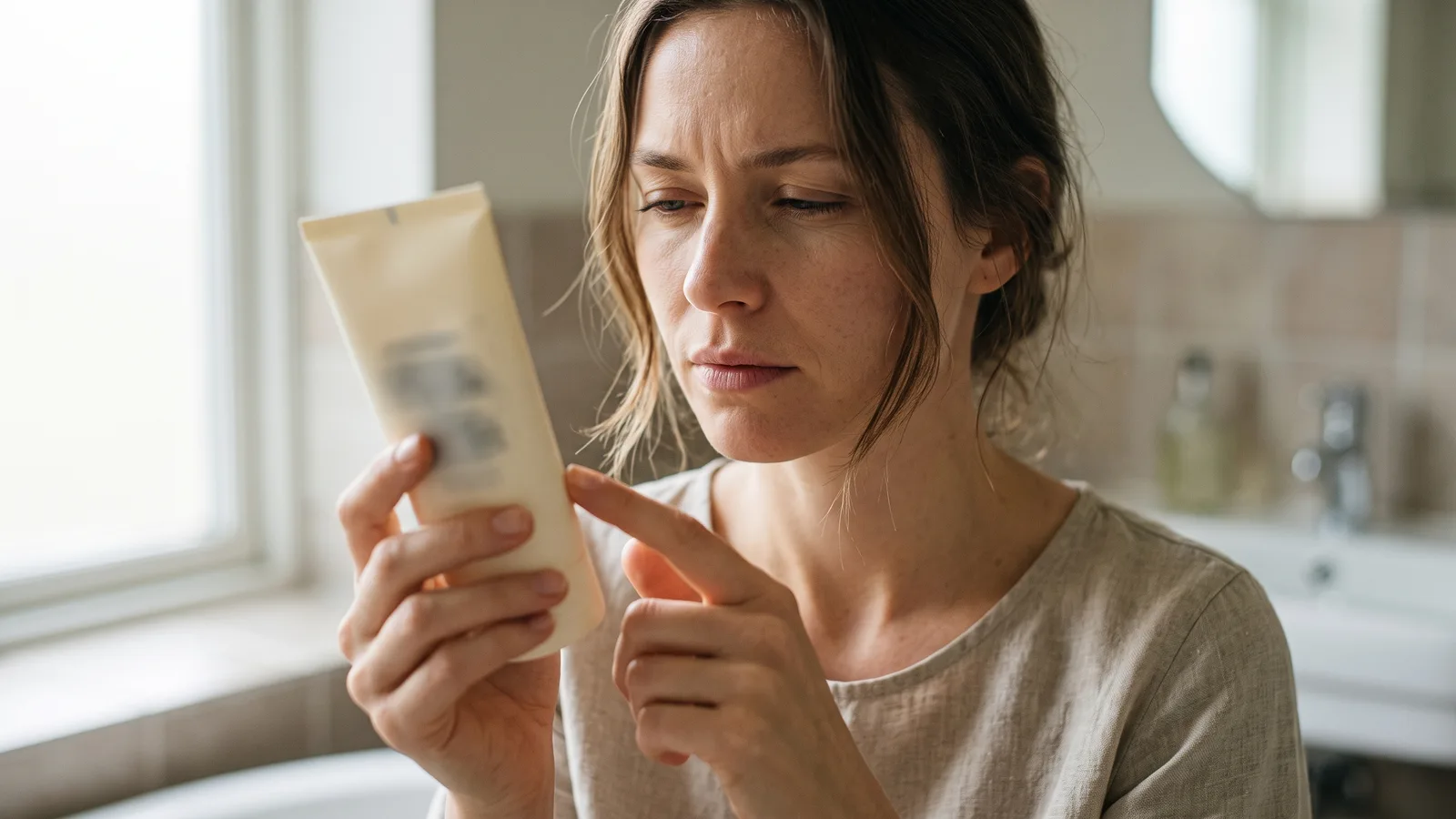
The manufacturer prints "with niacinamide" in big letters on the front of the tube. You flip the box over, look for niacinamide on the INCI list — and find it somewhere in the second half, right before the preservative. That doesn't mean the ad is lying. It means the ingredient may well be present in a trace amount at that position on the list. An INCI list, read in the right order, says more than the tagline on the box. And it takes ten minutes, not a chemistry degree.
Order on the list: from the largest amount to the smallest
Regulation (EC) No 1223/2009 requires cosmetic ingredients to be listed by their INCI names in descending order by weight at the time they're added to the product. This rule applies to ingredients above 1% concentration. Colorants — except hair dyes — may appear anywhere after the rest of the list, regardless of how much of them the product actually contains (kosmopedia.org). That's the only legal mechanism governing the order. Everything else you read from context.
The 1% line: where the hierarchy ends
Above 1%, the order is fixed by law. Below it, anything goes. It's the only formal cutoff point on the entire INCI list: from there, the manufacturer arranges ingredients however it likes, often in a way that sells the product nicely (kosmopedia.org; incidecoder.com). The catch: the label carries no marker saying "the 1% line ends here." You have to estimate it.
Three names usually help, since they tend to show up at low concentrations. Phenoxyethanol, a popular preservative, has a legal limit of 1% in the finished product (specialchem.com). Xanthan gum typically thickens at 0.1–0.5%, more rarely up to 2% (specialchem.com). Carrageenan in lotions usually doesn't exceed 0.2%. When these names start appearing on the list, you're most likely below the 1% zone. This is an estimate, not a rule. A specific formula might use phenoxyethanol at 0.3% or skip it entirely.
Why Aqua almost always comes first
Most creams, serums, and gels are water-based formulas, so water, as the base solvent, naturally weighs the most. Aqua at the top of the list doesn't mean a diluted product. It's just a regular emulsion or gel (incidecoder.com). No water at the start isn't a red flag either. You're then looking at an anhydrous formula: an oil or a butter-based balm. A different product type, same class.
The hero on the front and its real place on the list
An ingredient promoted in big letters on the front — "with hyaluronic acid," "with niacinamide" — can legally sit right at the 1% line or beyond it. It's sometimes present in trace amounts, even though the whole product is built around it communication-wise. The industry sometimes calls this "label dressing": the list is fully compliant with the law, but the hierarchy on the front of the box doesn't reflect the hierarchy of concentrations (serummaker.com). Practical check: see whether that ingredient sits before or after the markers from the previous section.
A specific percentage on the front — "Niacinamide 10%" — is a separate matter. The INCI list itself only enforces order by weight; it doesn't verify declared percentages. Those numbers fall under Regulation (EU) No 655/2013 on cosmetic claims. They have to be true and backed by evidence, but the ingredient list itself doesn't confirm them (ec.europa.eu). It's that advertising rule, not the ingredient's place on the list, that verifies a "10%" claim. Two different legal mechanisms.
INCI vs. the name on the box
Niacinamide is the INCI name for a molecule that marketing prefers to call "vitamin B3" — it sounds more approachable. The same rule governs ascorbic acid, which becomes "vitamin C" on the front of the box, and tocopherol, which turns into "vitamin E" (specialchem.com). The commercial name isn't a lie — it's simply a different register of language, consumer-facing instead of chemical. Niacinamide's typical formulation concentration falls in the 1–6% range. Industry literature most often cites around 5% as the effective level. I've written separately about how to pick a concentration and what to pair niacinamide with in the article on niacinamide without the myths. It's similar with vitamin C. The form on the INCI list — ascorbic acid, sodium ascorbate, ascorbyl glucoside — says more than the claim "with vitamin C" on its own. The guide to vitamin C forms breaks it down in more detail.
There's one more question that keeps coming back: why the whole INCI list is in English and Latin. The law requires Polish only for select elements of the label — package contents, shelf life, product function, and special precautions. The ingredient list itself deliberately stays in the international INCI nomenclature, so the same ingredient carries the same name across the entire European Union (kosmopedia.org).
"Free from" has rules, "clean" has no definition
"Paraben-free," "silicone-free" — claims like these have been regulated in the European Union since 2013. Regulation (EU) No 655/2013 sets six criteria for every cosmetic claim: legal compliance, truthfulness, evidential support, fairness, honesty, and informed decision-making. A 2017 Commission technical document, updated in July 2023, spells out the rules for "free from" claims in more detail (ec.europa.eu; ctpa.org.uk). You can't advertise the absence of an ingredient that's already legally banned. The absence has to be genuinely zero and verifiable, and the claim shouldn't target an ingredient that's rarely used in that product category to begin with. "Free from" is a claim with rules.
"Clean beauty" has none of that — because it has no definition. Not in the European Union, not in the United States. The FDA hasn't defined "clean," "natural," or "organic" for cosmetics — the USDA regulates "organic" only in agriculture (fda.gov). Every retailer — Target, Sephora, Credo, Whole Foods — has its own, separate exclusion list, some of them partly contradicting each other. For comparison: the US bans around 11 substances in cosmetics, while the EU restricts or bans more than 2,400 (uclawreview.org). Simple compliance with EU law is already a stricter filter than an informal "clean" list. "Clean" is a marketing category, not a scientific one. That's a judgment about the word itself, not an accusation against the brands that use it.
Parabens, silicones, SLS: what the data says
Parabens have a bad reputation from two decades ago, but the current state of knowledge looks different. The Scientific Committee on Consumer Safety (SCCS) issued final opinions in 2023 (cirs-group.com). Methylparaben is safe as a preservative up to a concentration of 0.4%, butylparaben up to 0.14%. Both opinions factored in an assessment of potential hormonal activity and still upheld safety at those concentrations. These limits apply to specific substances, set separately. They're not a blanket clearance for the whole paraben group. Since 2014, the EU has banned isopropylparaben, isobutylparaben, phenylparaben, benzylparaben, and pentylparaben. Propylparaben and butylparaben are additionally banned in products for the diaper area of children under three. The safety mechanism for the remaining parabens: estrogenic activity 1,000 to 100,000 times weaker than estradiol, with no tissue bioaccumulation (kosmopedia.org).
Silicones — dimethicone, cyclomethicone — have picked up the myth that they "suffocate the skin." Skin doesn't take in oxygen from the air through its pores; oxygen reaches its cells through the bloodstream. Silicones form a surface layer that's permeable to gases and water vapor. Dimethicone scores 0–1 on comedogenicity in standard tests, meaning it's practically non-comedogenic (labmuffin.com).
SLS, or sodium lauryl sulfate, is often demonized without regard for context. The CIR panel found it safe in rinse-off products — shampoos, shower gels. In leave-on products, the recommended maximum concentration is 1%. Irritation is dose-dependent: SLS becomes clearly irritating only from around 2% upward (cir-safety.org). The circulating myth about "SLS-induced blindness" traces back to an over-interpreted, old study using very high concentrations on damaged animal corneas.
Exercise: break down two ingredient lists in 10 minutes
Grab any moisturizer and run through its list using the same framework. A typical formula starts with Aqua. Next come emollients and humectants in larger amounts, then the active ingredient from the front of the box. Closer to the end — Phenoxyethanol, Xanthan Gum, Parfum, and colorants. Where the active ingredient sits relative to the preservative tells you more than the wording on the tube.
Do the same with an oil or a balm stick. Here, Aqua is often absent entirely — the list starts with a plant oil or a butter, because the formula is anhydrous. You immediately see a different architecture. After ten minutes of practicing with two different types of skincare, the habit sticks for good — next time, before you believe a claim on the front of the box, you'll flip it over and check for yourself.
References
- Regulation (EC) No 1223/2009 of the European Parliament and of the Council on cosmetic products, Art. 19 — labelling and INCI ordering source (related: source)
- Commission Regulation (EU) No 655/2013 and the Technical document on cosmetic claims (European Commission, 2017, updated VII 2023) — criteria for cosmetic claims, including "free from" source
- SCCS — Final Opinion on Methylparaben, SCCS/1652/23 (15.12.2023) source
- CIR (Cosmetic Ingredient Review) — safety assessment of Sodium Lauryl Sulfate source
- Lab Muffin Beauty Science (Dr. Michelle Wong) — "Silicone Mythbusting" source
- University of Cincinnati Law Review Blog — "Clean Beauty: A Void in Consumer Protection" (2024) source
- FDA — "Organic" Cosmetics source
- Kosmopedia.org — "Oznakowanie kosmetyków" and "Czy parabeny są bezpieczne?" source ; source
- IncDecoder — "How to read an ingredient list" source
- SpecialChem — INCI ingredient profiles: Phenoxyethanol, Xanthan Gum, Niacinamide source ; source ; source