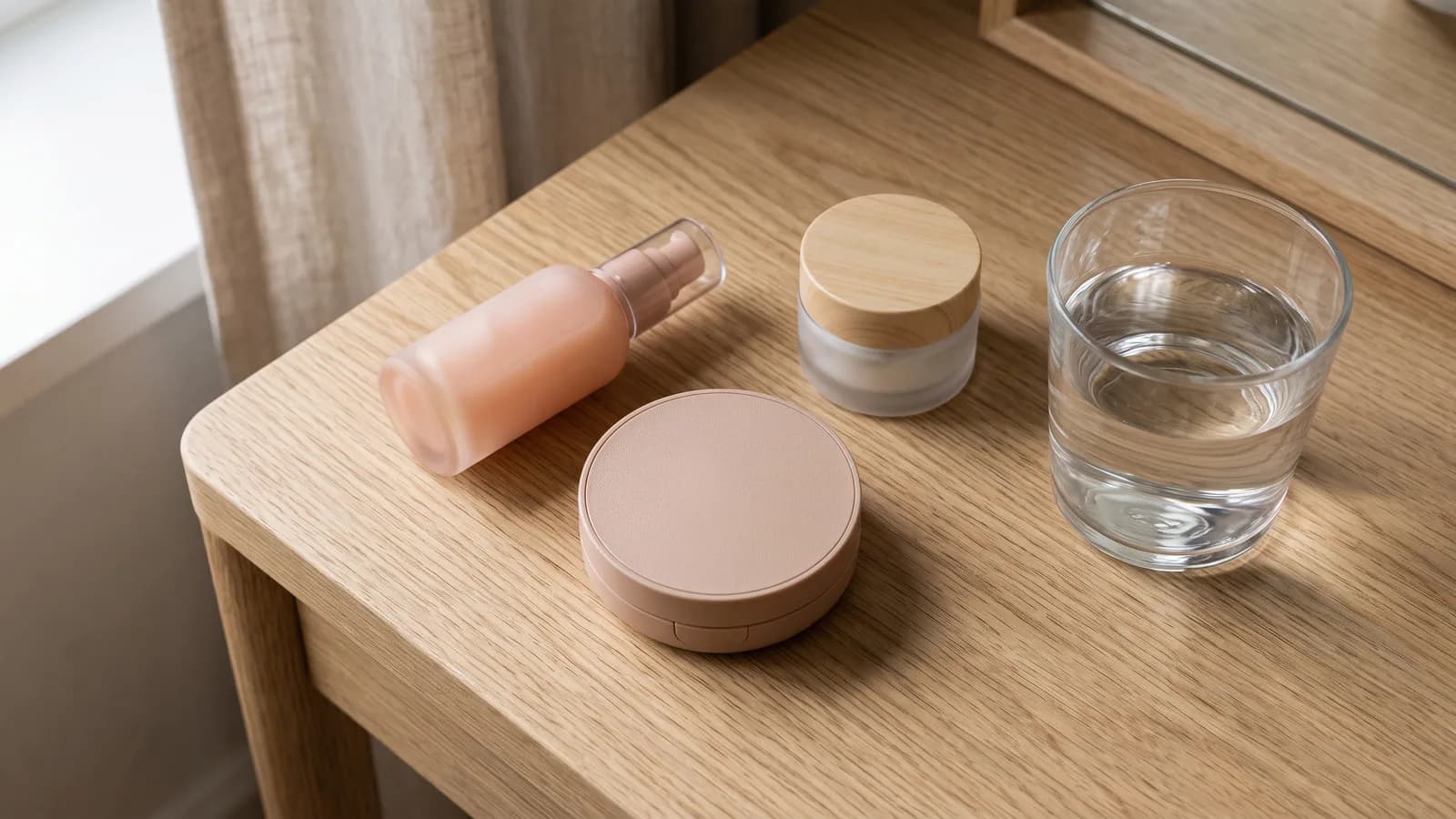
Rossmann already has a dedicated shelf for Korean cosmetics. That's not a coincidence. In 2026, k-beauty brands sold around PLN 330 million through Poland's drugstore channel — 76% more than a year earlier (Wiadomości Kosmetyczne, 2026). In under two years, Poland became the second-largest k-beauty market in Europe. Brands from the banks of the Han River now control around 10% of Poland's facial-skincare market. Sales aren't the same thing as evidence, though. UV filters, cica, and niacinamide have solid cosmetic chemistry behind them. Other trends are mostly good packaging and a strong TikTok algorithm.
How I tell evidence from marketing
Before I get to the list, one rule organizes the rest of this piece. What matters is the mechanism of action and the number of clinical trials on humans, not hashtag popularity. Niacinamide is a good reference point — an ingredient k-beauty popularized, and one that now has the best documentation of all. It inhibits melanosome transfer, which fades discoloration. It also strengthens the skin barrier and has anti-inflammatory effects. A review of 64 publications from 2020–2025 confirms these mechanisms consistently (PMC8389214, 2021). I've covered niacinamide concentrations and how to combine it in a separate article.
Cica and centella: this is where the evidence is strongest
Centella asiatica extract (in Korean marketing, "cica") has the strongest research backing of the entire k-beauty wave. Its triterpenoids — asiaticoside and madecassoside — stimulate collagen synthesis through the TGF-β/Smad pathway and act as anti-inflammatories by suppressing NF-κB. A 2025 clinical trial tested a formula with extracellular vesicles from centella. It reduced pore area by 17.9% and pore density by 26.9% (MDPI Cosmetics, 2025). Skin roughness dropped 9% after 28 days. A separate study of 100 people with sensitive skin showed improvement in redness and barrier function after just 4 weeks (PMC12274965, 2025). A patch test on 30 people showed no irritation at all. If your skin barrier happens to be compromised right now, I explain how to rebuild it step by step in a separate article — cica fits well into that process. Look for a serum or cream with a high concentration of centella asiatica extract near the top of the ingredient list (INCI), not a trace amount buried at the bottom.
Next-gen UV filters: this is where Korea genuinely leads the world
There's one thing about k-beauty I buy into without reservation: sunscreens. Korea's regulator, the MFDS, allows around 30 UV filters as "functional cosmetics" (Jane Yoo MD; KPTOWN). Among them are next-generation filters — Tinosorb S, Tinosorb M, Uvinul A Plus, Mexoryl XL. They give broad UVA protection in a lighter formula than older mineral filters. From the late 1990s until 2026, the US FDA didn't approve a single new UV filter. It wasn't until June 9, 2026 that it issued a decision adding bemotrizinol to the list (JHEOR, 2026). That's the exact same compound as the Korean and European Tinosorb S, used safely in Korea and the EU for more than 20 years. The new decision takes effect on August 9, 2026, at a permitted concentration of up to 6%. I've written separately about how to choose a daily SPF for your face — and Korean formulas really do come out on top there.
Cushion SPF: a convenient extra, not a replacement for a full layer
A cushion compact doesn't change the filter's chemistry — it changes how you apply it. Micro-droplets from the sponge are easier to reapply than a thick cream. The catch is specific, though. At half the recommended amount of product, protection drops disproportionately — down to as little as a third of the stated SPF (NewBeauty, 2026). Cushion works well as an extra layer and a way to reapply filter during the day. In the morning, it won't replace a full layer of regular SPF cream.
PDRN and the so-called "salmon DNA": the clinic is not the same as the drugstore jar
PDRN, or polydeoxyribonucleotide, is sometimes called "salmon DNA" on social media, since it's most often sourced from salmon DNA. The evidence for it is real, but it's almost entirely about clinic injections. Clinical trials comparing PDRN with a hyaluronic-acid-based filler show it has an edge in aesthetic assessment and skin roughness (Dermatology Times, 2026). PDRN is approved as a dermal filler in several countries. In Italy, it was approved for treating superficial wounds all the way back in 1994 (MDPI Applied Sciences, 2025).
The problem starts when you move to a cream or serum. The stratum corneum readily lets through molecules under about 500 daltons. That limits how much PDRN from a cream even reaches the skin at all. The first and so far only published clinical trial of topical PDRN dates from late 2025. A low-molecular-weight form derived from Chinese peony improved skin elasticity around the eyes after 4 weeks of application (PMC12785872, 2025) — one product, one parameter, four weeks. Korean experts sum it up bluntly. A standalone PDRN serum without delivery technology to get the ingredient deep into skin is, as of 2026, "pure hype," not something worth your money (Grazia USA, 2026). In the EU, PDRN isn't banned, but it also hasn't been formally assessed by EU cosmetic-ingredient safety experts. That's not the same as an active recommendation.
Exosomes: the loudest marketing, the weakest evidence
Exosomes are currently one of the fastest-growing k-beauty ingredients by sales, alongside PDRN, tranexamic acid, dexpanthenol, and EGF. That's sales data, though, not proof of efficacy (BeautyMatter, 2025). The US FDA hasn't approved a single exosome product for therapeutic use outside of clinical trials so far. What it is actively sending are warning letters — to Chara Biologics in January 2025, and to Supreme Rejuvenation in May 2025. The reason was therapeutic claims, including about psoriasis and rosacea (FDA, 2025). Even the market-size estimates for 2025 vary wildly, from around $268 to $500 million. That kind of spread says more about the quality of the data than the numbers themselves do. Exosomes in a cream's ingredient list are, for now, a marketing category. As a cosmetic active, they're still waiting for confirmation.
Snail mucin: promising, but the evidence is still thin
Snail mucin has more research behind it than PDRN or exosomes, but still not much. A systematic review from August 2025 found only 10 clinical trials involving humans (Journal of Integrative Dermatology, 2025). The results are positive — better hydration, elasticity, less water loss through the epidermis, faster healing after laser treatments. The trials are small, though, long-term data is missing, and in combination formulas it's hard to separate the effect of the mucin itself from the other ingredients. It's an ingredient with real, if still early, confirmation. It's a long way from a sure thing.
Glass skin and the 7 skins ritual: an aesthetic giving way to simpler routines
Glass skin — perfectly smooth skin as the goal — was the peak of k-beauty around 2023–2024. Today, trade press talks more often about "skinimalism 2.0": fewer steps, more ingredients with real effects (Beauty Independent, 2026). TikTok remains the main place where this trend lives. 65% of Gen Z and 55% of millennials look for cosmetics there before buying (WWD, 2026). The hashtag #skincare alone generated around $142 million in TikTok Shop sales over the past 12 months. The "7 skins" method belongs to the same aesthetic — applying seven layers of toner or essence one after another. No peer-reviewed study backs it up — it's pure tradition and marketing. Layering multiple active ingredients at once is more likely to strain the skin barrier than help it. If you like essences, stick with one well-chosen one, not seven.
Korean cosmetic chemistry really is strong — UV filters and cica are the best proof of that. Everything else deserves the same question as any new trend: is there a mechanism and a human study behind it, or just a good video? Sign up for the Lucevio newsletter if you want trend filters like this one before you spend money on the next TikTok hit.
References
- Dermatology Times — "Social Media Mythbusters: PDRN Serums." Accessed: 2026-07-19. source
- "Anti-Aging Efficacy of Low-Molecular-Weight Polydeoxyribonucleotide Derived from Paeonia lactiflora," PMC12785872, 2025. Accessed: 2026-07-19. source
- MDPI Applied Sciences — "Polydeoxyribonucleotides as Emerging Therapeutics for Skin," 2025;15(19):10437. DOI: 10.3390/app151910437. Accessed: 2026-07-19. source
- Journal of Integrative Dermatology — "Snails and Skin: A Systematic Review," 2025. DOI: 10.64550/joid.my5hzr63. Accessed: 2026-07-19. source
- MDPI Cosmetics — "Clinical Efficacy and Safety Evaluation of a Centella asiatica (CICA)-Derived Extracellular Vesicle Formulation," 2025;12(4):135. Accessed: 2026-07-19. source
- PMC12274965 — "The Effectiveness and Safety of a Skin Care Product With Centella asiatica Leaf Extract in Subjects With Sensitive Skin," 2025. Accessed: 2026-07-19. source
- PMC8389214 — "Mechanistic Basis and Clinical Evidence for the Applications of Nicotinamide (Niacinamide)," 2021. Accessed: 2026-07-19. source
- Jane Yoo MD — "Korean Sunscreens: More Filters for Protection." Accessed: 2026-07-19. source
- KPTOWN — "Korean Sunscreen vs American Sunscreen UV Filters." Accessed: 2026-07-19. source
- JHEOR — "What's Keeping the US From Allowing Better Sunscreens," 2026. Accessed: 2026-07-19. source
- NewBeauty — "Trending Cushion Sunscreens Are Convenient, But Are They Effective?" 2026. Accessed: 2026-07-19. source
- FDA — Warning Letter, Supreme Rejuvenation LLC, 2025-05-05. Accessed: 2026-07-19. source
- BeautyMatter — "2026 K-Beauty Forecast: Top 7 Data-Backed Trends," 2025. Accessed: 2026-07-19. source
- Grazia USA — "Korean Skin Experts Reveal Which 2026 K-Beauty Trends Are Actually Worth Your Money-and Which Are Pure Hype," 2026. Accessed: 2026-07-19. source
- Beauty Independent — "Top Skincare Trends For 2026-And Those Losing Their Sizzle," 2026. Accessed: 2026-07-19. source
- WWD — "TikTok Shop Beauty Sales: Medicube, Dr. Melaxin, Skincare," 2026. Accessed: 2026-07-19. source
- Wiadomości Kosmetyczne — "K-beauty opuszcza niszę. Masowa ekspansja zmieni reguły gry na polskim rynku kosmetycznym," 2026. Accessed: 2026-07-19. source