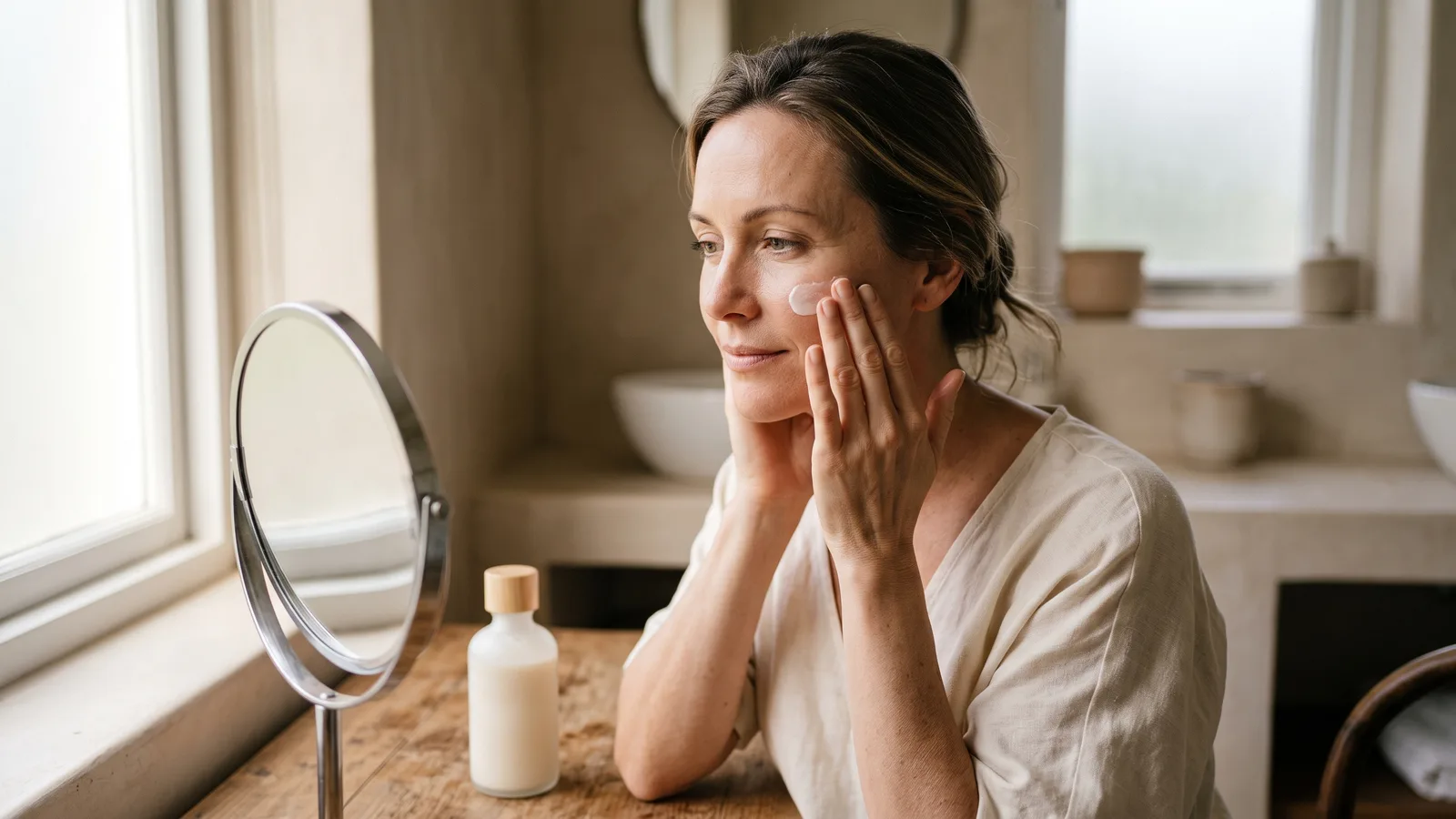
You're 45, and the retinol cream that worked in a month at thirty barely changes anything now. That's not a worse product, and it's not less discipline. In the first five years of menopause, skin can lose up to 30% of its collagen (American Academy of Dermatology). After that, the loss slows down, but it doesn't stop — it continues for roughly two more decades. Before you reach for another jar "for menopause," it helps to understand the mechanism — and what no skincare product can reverse.
What estrogen does in your skin — before you start losing it
Estrogen acts in the skin through ERα and ERβ receptors, present in fibroblasts, keratinocytes, melanocytes, hair follicles, and sebaceous glands. When the hormone is abundant, fibroblasts work hard — producing collagen, elastin, and hyaluronic acid. When estrogen drops, the opposite happens, and in two ways at once. Fibroblasts produce fewer fibers, while the activity of MMP enzymes, which break down the existing skin matrix, increases (Viscomi et al., Journal of Cosmetic Dermatology 2025). Less building and more breakdown at the same time — which is why the pace of change after 40 can outrun what the calendar suggests.
How much collagen you actually lose
The most frequently cited figure comes from the AAD: in the first five years of menopause, skin loses up to 30% of its collagen. A 2025 scientific review reports a different pace: about 2.1% per year over the following 15 years. Skin thickness drops during this time by roughly 1.13% a year, for nearly two decades (Viscomi et al. 2025). The numbers don't add up one to one — they come from different studies and different measurement methods. What they show is a direction of change, not an exact date on the calendar.
The barrier weakens — and it's measurable
Menopause also changes the composition of ceramides in the stratum corneum — they become shorter and fewer. The result is higher transepidermal water loss (TEWL), meaning skin genuinely holds less moisture (Källström et al., Scientific Reports 2022). The most interesting part of that study: in women on hormone therapy, these changes don't occur at all, or are much smaller. It's estrogen that regulates this parameter, not skincare alone — which is why the barrier needs more attention after 40 than it did before. I've covered how to repair it in a separate article.
Skin healing slows down
Estrogen also supports the healing of micro-injuries — it regulates inflammation and the cytokines involved in tissue regeneration. After menopause, this mechanism weakens, so small cuts, post-treatment irritation, or acne marks fade more slowly than before (Sadur et al., Journal of Integrative Dermatology 2025). That's a good reason to introduce new active ingredients gradually after 40, rather than all at once.
What skincare can actually do
In its recommendations for menopausal skin, the AAD names four specific things. Retinoids and peptides — they support collagen production. Hydration — hyaluronic acid, glycerin, and ceramides hold water in the skin and strengthen the barrier. Salicylic acid — for hormonal acne, which can be an unexpected guest during this period. Daily SPF 30+, because thinner skin is more vulnerable to sun damage (AAD). I've written a separate article on choosing a retinol concentration and pairing it with peptides.
In an evening cream, look for a combination of ceramides and peptides — the first rebuild the barrier, the second signal the skin to produce collagen. CeraVe Moisturizing Cream has three ceramides and hyaluronic acid in one formula — a good base to layer an additional peptide serum on top.
Choose an SPF you'll actually apply every day. Mineral or chemical filter, cream, stick, or under makeup — they all protect, so let texture be your guide. What matters is that it becomes a daily habit, all year round.
What skincare can't replace
The AAD's own guide to menopause doesn't mention hormone therapy at all. For dermatologists writing for patients, these are two separate topics — and this article keeps them separate too. Still, it helps to know the scale of change hormone therapy can produce, to understand what skincare can't recreate. In clinical studies, hormone therapy increased skin thickness by up to 11.5%, and dermal thickness by 33%, with conjugated equine estrogens. On top of that came an elasticity improvement of around 40–60% versus the untreated group, and 7–15% greater skin thickness after roughly five years of therapy (Viscomi et al. 2025). These are systemic effects — the hormone acts throughout the body, not just where you apply a cream. The review itself states plainly that skincare on its own doesn't recreate this. This is a description of a mechanism from research, not a nudge toward hormone therapy — more on that choice below.
Phytoestrogens in creams: what the research shows
Interest in menopause-focused skincare is growing. Searches for related terms reportedly rose by about half, year over year. Depending on the research firm, the "menopause skincare" market is valued at $1.3 billion to nearly $3 billion by 2033 (BeautyMatter; Grand View Research). Phytoestrogens are one of the trend's leading buzzwords — and a good example of how an ingredient's popularity doesn't always track with the evidence.
Soy isoflavones — genistein, daidzein, glycitein — structurally resemble 17β-estradiol and bind to estrogen receptors, mainly ERβ. Their estrogenic activity, however, is markedly weaker than that of pharmaceutical hormones (Li et al., Frontiers in Nutrition 2025). The review itself doesn't cover skin — it describes systemic menopause symptoms, such as hot flashes and bone density. No phytoestrogen-based drug has FDA or EMA approval.
The only concrete numbers on phytoestrogens and skin come from an oral supplement, not a cream. In a double-blind study, 44 postmenopausal women took 30 g of soy protein daily with 50 mg of isoflavones for 24 weeks. Wrinkles decreased by 5.9–7.1%, pigmentation by 2.4–2.5%, and hydration increased by 39–68% (Rizzo et al., Nutrients 2023). Before this sounds like a case for an isoflavone cream: the study was funded by the United Soybean Board, and the lead author disclosed ties to cosmetics companies. The sample was small, covering only four lighter skin phototypes, and above all — this is a supplement, not something you apply to your face.
The EU regulator (SCCS) permits genistein in cosmetics only up to a concentration of 0.007%. It considers daidzein's safety only partially resolved, allowing up to 0.02% under specific conditions — both compounds made the priority list of potential endocrine-disrupting substances (SCCS, summary: PersonalCareInsights). In other words: in a cream that's legally sold on EU shelves, there isn't enough phytoestrogen to act systemically like a hormone. If the label suggests otherwise, that's marketing, not pharmacology.
HRT is a decision you make with your doctor
Hormone therapy isn't used solely for a cosmetic effect. There's currently no separate, approved therapy for the skin changes of menopause, and the safety of absorption even from topical estrogen still needs more research (Sadur et al. 2025). The Menopause Society describes the decision about HRT as a shared decision made with a doctor, based on an individual assessment of risks and benefits. For some healthy, symptomatic women under 60 or within ten years of their last period, the benefits usually outweigh the risks. It's always an individual assessment (The Menopause Society, 2022 position statement). This article doesn't advise for or against HRT. That conversation belongs with your gynecologist, not a product description.
Skin after 40 needs fewer promises and more consistency: a retinoid matched to your tolerance, a barrier cream every day, and an SPF you actually use. Everything else — including the decision about HRT — is a conversation for a different office than the drugstore aisle.
References
- American Academy of Dermatology — "Caring for your skin in menopause". source. Accessed: 2026-07-19.
- Viscomi B., Muniz M., Sattler S. (2025). "Managing Menopausal Skin Changes: A Narrative Review of Skin Quality Changes, Their Aesthetic Impact, and the Actual Role of Hormone Replacement Therapy in Improvement". Journal of Cosmetic Dermatology. DOI: 10.1111/jocd.70393 source
- Källström A. et al. (2022). "Menopause induces changes to the stratum corneum ceramide profile, which are prevented by hormone replacement therapy". Scientific Reports. DOI: 10.1038/s41598-022-26095-0 source
- Sadur et al. (2025). "Beyond Hot Flashes: Understanding and Treating Menopause-Associated Skin Changes". Journal of Integrative Dermatology. DOI: 10.64550/joid.jzw4me05 source
- The Menopause Society (2022). Hormone Therapy Position Statement. source
- Li et al. (2025). "Exploring the anti-aging potential of phytoestrogens: focus on molecular mechanisms and menopausal symptom modulation". Frontiers in Nutrition. DOI: 10.3389/fnut.2025.1651367 source
- Rizzo et al. (2023). "Soy Protein Containing Isoflavones Improves Facial Signs of Photoaging and Skin Hydration in Postmenopausal Women". Nutrients. DOI: 10.3390/nu15194113 source
- SCCS — final opinion on genistein and daidzein in cosmetics (industry summaries). source and source
- BeautyMatter — "The Perimenopause Opportunity Beauty Can't Ignore". source
- Grand View Research — Menopause Skin Care Market Size Report. source