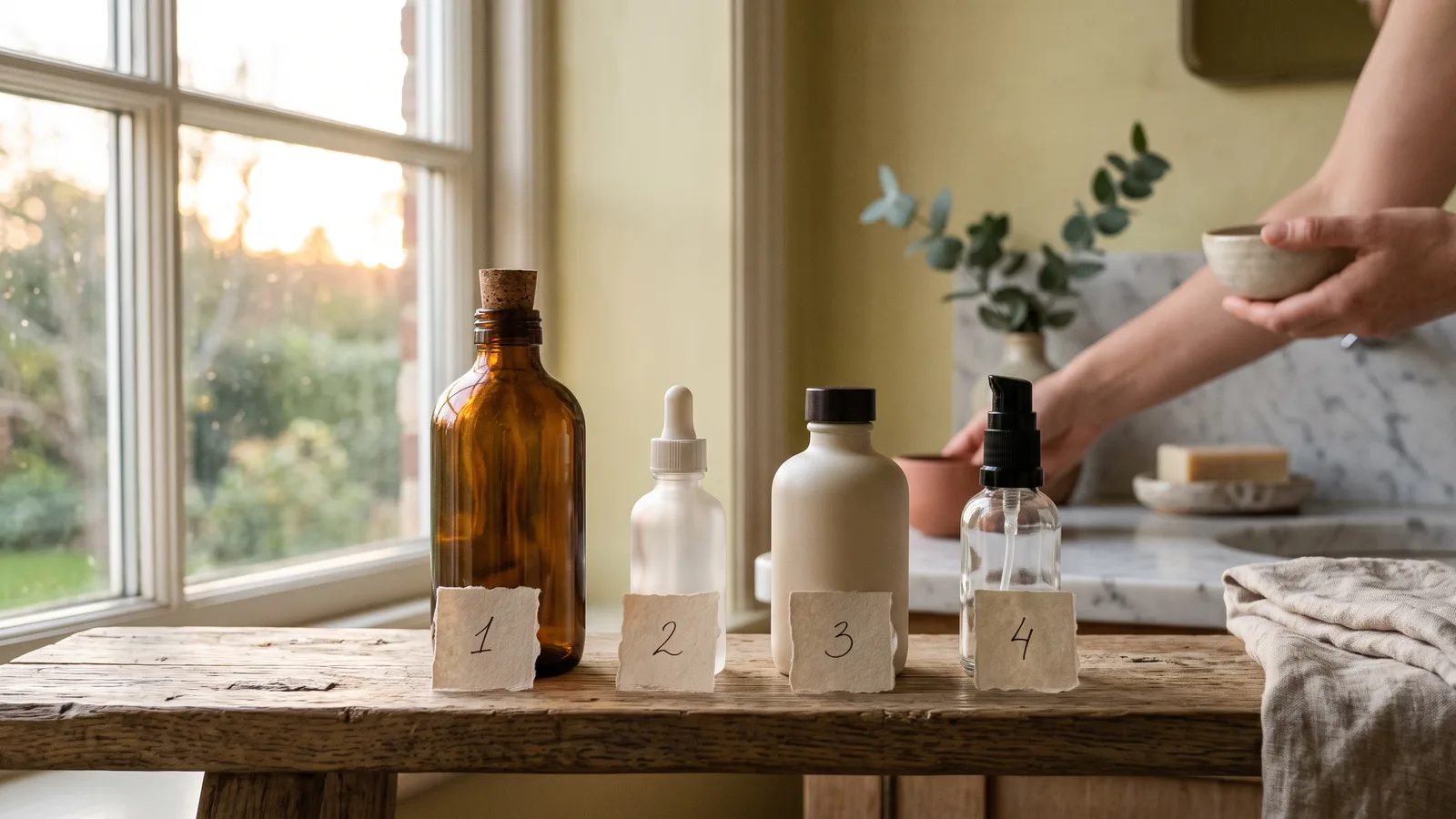
You've got acid, retinol, vitamin C, and a ceramide cream on your shelf — and the same question every night: what goes on tonight without wrecking anything. Monday it's retinol, Tuesday you add acid because your skin looks dull, Wednesday it stings and you can't tell which product is to blame. Your skin is irritated, tight, flaking in places — and you feel like you're doing everything at once and nothing on purpose. The problem is rarely the products themselves. It's the order they go on in — or rather, the lack of one.
Skin cycling sorts this into four simple nights. You don't buy anything new — you put what you already have into sequence.
Where the approach comes from
Dr. Whitney Bowe, a New York dermatologist, came up with the method. In her practice, she saw patients layering acids, retinoids, and serums one on top of another until their skin rebelled with irritation (Whitney Bowe Beauty). She calls this approach the "kitchen sink" of skincare — throwing everything in at once and hoping something works. The method went viral on TikTok, racking up roughly 3.5 billion views. The number alone proves nothing, but it shows how many people were searching for a plan instead of one more ingredient.
To be upfront: this is a practical, clinically developed protocol, not a method tested in its own controlled study. The sources writing about it say so themselves: Healthline and Ohio State University Wexner Medical Center state plainly that no study has evaluated the whole schedule. What does exist is solid, separate evidence for acids and retinoids individually. So skin cycling isn't a drug with a package insert — it's a way of arranging proven ingredients so they stop stepping on each other's toes.
Four nights, one plan
Dr. Bowe laid out the schedule, and Dr. Susan Massick of Ohio State Wexner Medical Center confirmed it independently — the two versions match, night for night (Ohio State).
Night 1 — exfoliation. A chemical exfoliant with AHA or BHA acids clears away dead skin cells and preps your skin for the retinoid the next night. Picking the right acid and concentration is its own topic — we cover it in more depth in our article on acids for home skincare.
Night 2 — retinoid. Retinol, retinal, or a prescription retinoid — applied to dry, cleansed skin, never damp, since moisture raises the risk of irritation (Dermstore). You'll find the mechanism and how to choose a concentration in our article on retinol and peptides after 30.
Nights 3–4 — recovery. Two nights with no acids or retinoids — just a cream with ceramides and humectants like hyaluronic acid or glycerin, which rebuilds the barrier (Ohio State). The whole CeraVe moisturizer line contains three ceramides that help lock in moisture and rebuild the skin's protective barrier. For these two nights, reach for the richer CeraVe Moisturizing Cream or the lighter CeraVe PM Facial Moisturizing Lotion. We cover exactly what happens in the barrier, and why recovery takes two nights instead of one, in our article on rebuilding the hydrolipidic barrier.
After night 4, the cycle starts over, from night 1.
What the breaks are for
Dr. Bowe compares skin recovery to muscle recovery after a workout: muscles need rest days, and so does skin. The typical mistake is skipping the nights when the barrier gets to recover (Whitney Bowe Beauty). Using strong actives too often or at the same time — acids together with retinoids — can damage the skin barrier and lead to irritation and inflammation. Spacing them out protects the barrier and lets each ingredient do its job without irritation piling up (Healthline).
When four nights is too much or too little
The standard cycle is a starting point, not a fixed rule. Oily, breakout-prone skin tolerates more frequent stimulation. You can shorten the cycle to three nights: a stronger retinoid and just one recovery night before repeating. This skin type has more of its own sebum, so hydration matters less (Ohio State).
Dry, sensitive skin, or skin prone to redness, needs more time to recover. It's worth extending the cycle to five or even six nights, with three or four recovery nights instead of two (Ohio State). Dr. Bowe calls this variant gentle skin cycling. If you have inflammatory acne, psoriasis, atopic dermatitis, or heavily pigmented skin, talk to a dermatologist before starting the cycle — some conditions call for a different rhythm, not just less frequent actives (Healthline).
What about mornings?
The cycle only applies to evenings. Your morning routine stays the same no matter which night of the cycle you're on: cleanse, vitamin C if you use it, moisturize, and SPF. The SPF part is non-negotiable, since acids and retinoids increase your skin's sun sensitivity (Ohio State). Vitamin C belongs right here, as an antioxidant serum under your moisturizer and sunscreen in the morning — not in the evening cycle of actives (Dermstore).
Three mistakes that ruin the whole plan
First: adding vitamin C to your evening. It's a morning ingredient — tacked onto an acid or retinoid night, it only raises the risk of irritation without any added benefit.
Second: treating recovery nights as "do nothing" nights. They're an active part of the plan — hydration and barrier repair — not a gap where you can squeeze in another active. Skipping these nights, or swapping them for something stronger, defeats the whole point of the cycle (Whitney Bowe Beauty).
Third: acid and retinoid on the same night. Both ingredients speed up skin cell turnover, and together they raise the risk of irritation instead of complementing each other. That's why skin cycling keeps them apart. Exfoliating the night before clears away the layer of dead cells, so the retinoid penetrates better the following night — at the cost of extra sensitivity, which the next two recovery nights calm back down (Today).
Start with one cycle
Pick three products you already own, or are still choosing: an exfoliant, a retinoid, and a ceramide cream. Write them down on paper or in your phone: night 1, night 2, night 3, night 4. Go through one full cycle before deciding whether you need a shorter or longer version. A plan you follow on paper, not by feel, is the simplest way to stop guessing every evening from scratch.
References
- Dr. Whitney Bowe Beauty — "Classic Skin Cycling: Why It's Gone Viral and How to Do It" source
- Ohio State University Wexner Medical Center, Dr. Susan Massick — "A step-by-step guide on how to 'skin cycle'" source
- Healthline — "Skin Cycling: Products Needed, Routine, Benefits, and Precautions" source
- Dermstore — "The Ultimate Guide to Skin Cycling With Dr. Whitney Bowe" source
- CeraVe — moisturizer product page source
- Today.com — "What is skin cycling? Derms break down the TikTok trend" source
- The INKEY List — "Skin Cycling Guide: Rotate Retinol & Active Ingredients Like a Pro" source