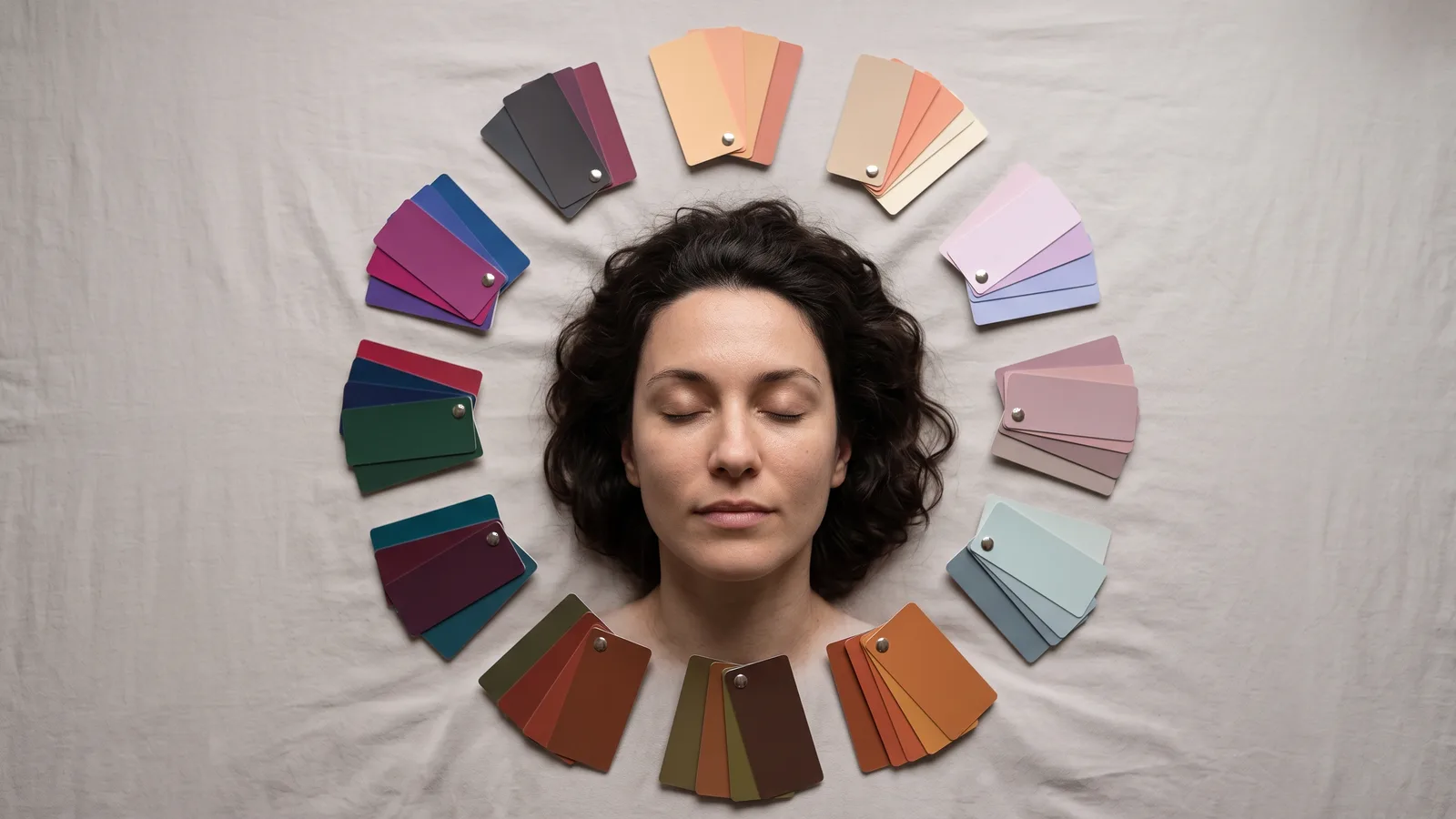
You know you're a Winter. Your friend spotted it immediately — cool navy and plum sit better on you than anything warm, and in white you look like you stepped off a magazine cover. But when you grab a ready-made "Winter palette" off the internet, half the colors work and half wash you out like three hours of sleep. That's because Winter isn't one type — it's three: Bright, True, and Deep, each with its own flagship colors and its own metal at the face.
Every season is described by three dimensions: warmth, lightness, and saturation. Whichever one dominates in your coloring splits the season into three subtypes. I've already written about these dimensions in the piece on the science behind color analysis. Below you'll find all twelve, grouped into the four seasons. The traits, flagship colors, and metals here are based on a guide to the twelve color seasons.
Springs
All Springs are warm. Only lightness and clarity of color set them apart.
Light Spring
Delicacy: light blonde or light brown hair, light eyes, peach or cream skin, low to moderate contrast. Reach for peach, light coral pink, mint, and buttery yellow — they won't overwhelm your softness. Skip black, neons, and colors as heavy as tar. Metal: gold, rose gold.
True Spring
The warmest of the family: a golden, peachy undertone without a trace of cool, hair in warm brown or strawberry blonde, moderate to high contrast. Your colors are peach, warm salmon, golden yellow, and grassy green. Leave cool grays, icy blue, and black on the shelf — on you, they look borrowed. Metal: gold, rose gold.
Bright Spring
One of the most contrasting types in the whole dozen — eyes light and glassy, skin ranging from fair to tan, hair warm, often sun-lightened. Some schools call it Clear Spring instead — a naming variant I'll come back to shortly. Your colors: cobalt, emerald, lemon yellow, poppy red. Avoid muted, broken-down shades. Metal: gold above all, though a shimmery finish can carry silver too.
Summers
What unites all Summers is coolness. What divides them is how light and how muted each one is.
Light Summer
Very light, delicate complexion with a cool undertone, ashy blonde or light brown hair, blue or blue-gray eyes, low contrast. Your colors: powder blue, soft lavender, powder pink, pale sage. Sharp warm colors — orange, rust, mustard — and heavy black wash you out instantly. Metal: silver, white gold.
True Summer
A distinctly cool, "powdery" coloring — ashy brown hair or mousy blonde, cool blue or gray eyes, moderate contrast. Reach for muted pink, soft turquoise, raspberry, and blue-gray. Warm yellows, oranges, and earthy browns fight your coloring. Metal: silver, white gold.
Soft Summer
Low contrast and a coloring that blends together — medium ashy brown hair, muted gray-green or gray-blue eyes. Your palette: sage green, dusty blue, soft plum, dusty rose. Bright colors and the sharp contrast of black against white are too loud for you. Metal: silver, rose gold.
Autumns
Autumn warmth has a different character than Spring's: more earthy, less luminous. What separates the subtypes is depth and degree of muting.
Soft Autumn
Warm but muted: golden-brown hair or dark blonde, hazel or olive-green eyes, warm beige skin, low to moderate contrast. Flagship colors: camel, warm taupe, dusty pink, olive. Icy pastels and neons clash with your warmth. Metal: gold, rose gold.
True Autumn
The most "autumnal" of the three — always warm, golden colors with a yellow or red base. Chestnut or red hair, warm brown or green eyes. Reach for burnt orange, olive green, rust, deep gold. Cool pink and icy blue turn your skin sallow. Metal: gold, rose gold.
Deep Autumn
The most pigmented of the family: it combines Autumn's warmth with Winter's depth. High contrast, dark brown or black hair, deep brown eyes, skin from olive to dark brown. Your palette: chocolate brown, deep olive, burgundy, dark teal. Pastels and washed-out colors make you disappear. Metal: gold, rose gold — copper works well too.
Winters
Winters carry the most striking cool of all four seasons. What divides them is contrast and depth.
Bright Winter
High contrast and a lot of energy: dark hair against light, striking eyes, clear skin, a "wow" effect at first glance. Colors: electric blue, fuchsia, bright turquoise, cherry red. Muted, earthy, and beige colors wash you out. Metal: silver, white gold — platinum works well too.
True Winter
Frosty and dazzling. Dark hair, fair cool skin, vivid eyes in icy blue or dark brown, very high contrast. Your colors: icy pink, true blue, hot magenta, lemon yellow. Warm, muted, and earthy shades simply die on you. Metal: silver, white gold.
Deep Winter
Striking contrast — near-black hair, deep brown or cool dark eyes, skin from porcelain to deep olive. Reach for black, true red, emerald, dark navy. Warm orange and beige blur your depth. Metal: silver, white gold.
Where these different names come from
If you've read other sites about color types, you might have gotten lost — the same type gets called different things depending on the school. "Bright" is sometimes "Clear" (Bright Spring = Clear Spring), "Deep" is sometimes "Dark" (Deep Autumn = Dark Autumn), and "True" gets replaced with a straight description of the dominant trait — "Warm Spring" or "Cool Summer." There's no single central authority approving these labels: different styling schools don't always agree on names or on where one type ends and the next begins.
The naming actually converges more than it first appears. Two independent stylists, Aleksandra Frątczak-Biś and Izabela Orłowska, independently arrive at the same twelve boundaries used in this piece. The only synonym pairing explicitly confirmed across sources is Bright Spring = Clear Spring. The rest of the naming variants (Light/Soft, Deep/Dark, and so on) come from how each source describes the dominant trait — that's an editorial reading, not a quoted dictionary entry.
The twelve-type division itself was created by Kathryn Kalisz in the Sci/ART system, launched in 2000. It added the third dimension, saturation, to the classic four-season division from the 1980s. Some schools go further and propose sixteen types, to catch cases that fall on the border between two neighboring seasons. As the industry itself admits, there's no single official version of this extended system.
And if you're in between
That's normal. The closer you are to the middle of the scale — neutral undertone, medium contrast, medium saturation — the more likely that colors from two neighboring palettes both work on you. Start with what you already know: check your undertone and your contrast level. Those two clues narrow twelve types down to two, maybe three. As one Polish stylist puts it, "Color analysis is a creative matter, and its result is tailored to each of us to help, not to limit". A label is a starting point, not a verdict.
The surest way to check without guessing from tables online? Glow Analysis reads your undertone, contrast, and palette from a few photos taken in natural light, and shows you exactly which of the twelve spots you actually stand in.
References
- mycolorseasons.com – "The 12 Color Seasons: Complete Guide to Seasonal Color Analysis" source
- theconceptwardrobe.com – "Bright Spring: A Comprehensive Guide" (and sister pages: Light Spring, True Spring, True Autumn, Soft Autumn) source
- kodstylu.pl (Aleksandra Frątczak-Biś) – "12 typów kolorystycznych" source
- iorlowska.pl (Izabela Orłowska) – "12 typów urody" source
- colorallure.com – "12-Season Color System" source
- stylewithdc.com – "The 16 Season Color Analysis System: A Comprehensive Guide" source
- chromology.co.uk – "The Sci\ART™ Personal Colour Analysis System" source