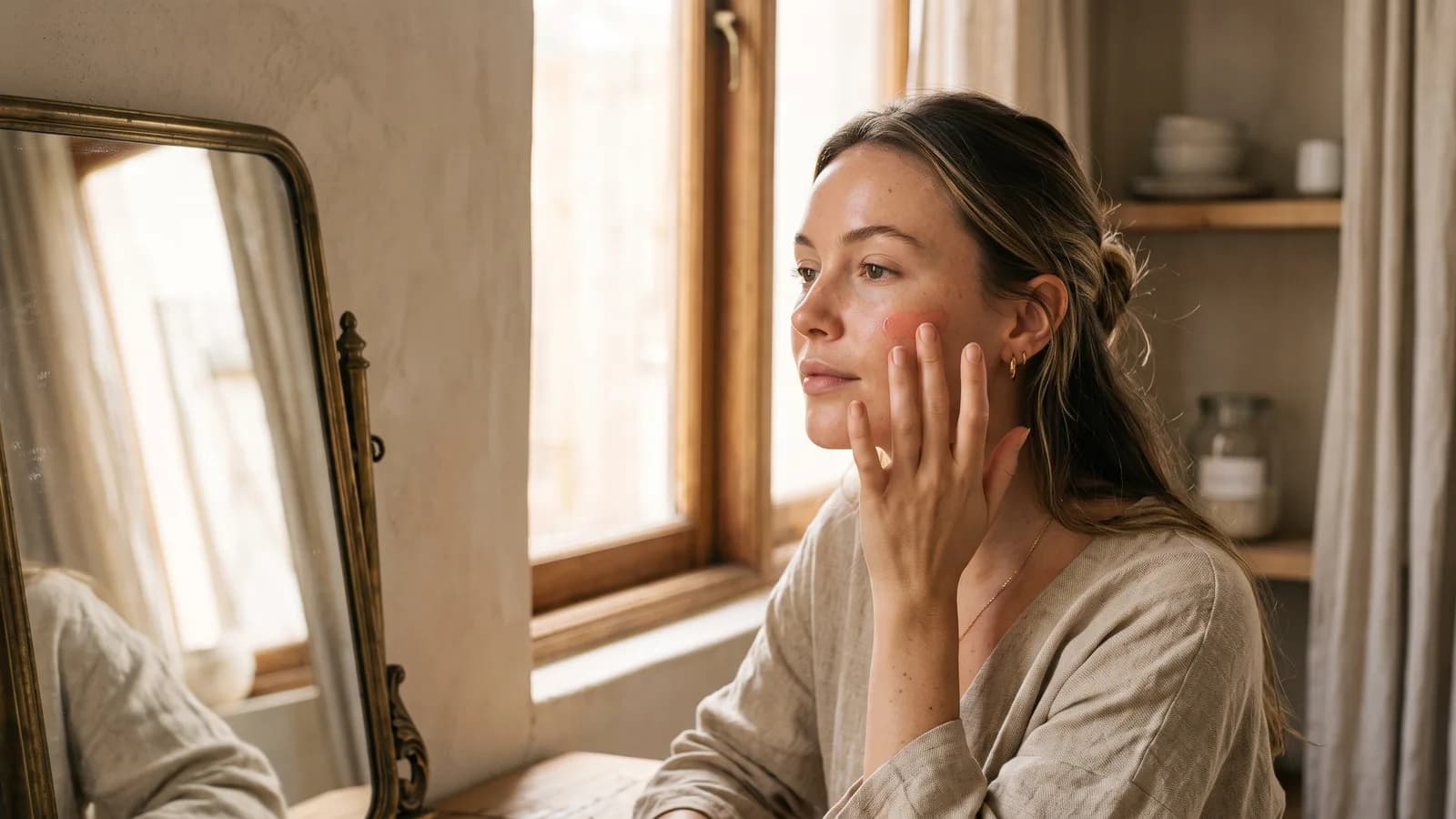
You apply foundation in the morning, and by midday your face in the mirror looks like a mask. You swap it for a skin tint, and suddenly it looks like you, just rested. Behind that difference is a different category of product entirely: different coverage, different texture. I check what actually separates hybrids from foundation, how to apply them in 5 minutes, and how to match the shade so it works with your colour type.
Skin tint, tinted moisturizer, foundation: three different coverage categories
Skin tint gives coverage described as practically zero. Its job is to brighten the complexion; masking is left to foundation. Tinted moisturizer covers roughly 15–20% less than classic foundation, while foundation itself spans medium to full coverage (Live Tinted, 2026). The textures track that split: skin tint is fluid, almost like a serum, tinted moisturizer is more of a creamy balm, and foundation is the thickest. That plays out in wear time too — tinted moisturizer lasts 4–8 hours, foundation 8–12 (Live Tinted, 2026). You'll likely touch up a hybrid partway through the day — that's a different trade-off: less mask on your face, more breathing skin.
Why a hybrid feels more like skincare than makeup
Many skin tints and tinted moisturizers contain hyaluronic acid or niacinamide — which is why they feel like you're applying a skincare serum. Sephora already runs a separate "skin care-makeup hybrid" category with brands like Ilia and Bobbi Brown (Modern Retail, 2026; GCI Magazine, 2026). The scale shows up in the data: 53% of makeup shoppers now look for hybrid products, up 6 percentage points from 2022 (Circana, cited in GCI Magazine, 2026). The industry is moving in one direction: less "glass skin" shine, more of a "skin, just better" effect (Who What Wear, 2026).
The 5-minute technique
- Skin tint or tinted moisturizer. Three dots — on your cheeks and forehead — blended out with your fingertips from the centre of your face outward. Fingers warm the formula and melt it into skin better than a brush.
- Cream blush. Smile, apply to the apples of your cheeks, and pat it in before the product has a chance to set. The same gesture on the tip of your nose and eyelids gives a consistent, "flushed" effect without a separate highlighter.
- Concealer only where you truly need it — under the eyes or on a single blemish. The rest of your face stays uncovered.
- Tinted lip balm — pat it in with a fingertip; the colour should stay uneven and lively.
- Brow gel brushed against the direction of hair growth, then back up. The same technique is behind the enduring "soap brows" trend — a damp spoolie lifts the hairs and gives the effect of fuller brows without a pencil (NYX Cosmetics, 2026).
Cream blush is back today as a bigger category than powder blush, often layered in several shades — the so-called "draped blush" technique (Who What Wear, 2026). For a light, dewy formula, NYX Wonder Stick Cream Blush works well — a stick format with hyaluronic acid. It runs about 45.99 zł at Rossmann.
SPF in a hybrid: why it isn't enough on its own
I have to be honest with you here. The SPF value on the label is measured at a layer of 2 mg/cm². In practice, we apply about 0.5 mg/cm² on average — a quarter of that amount, regardless of skin type (Kim et al., J Am Acad Dermatol 2010). The relationship isn't linear: a thinner layer lowers real protection more sharply than a simple proportion would suggest. In a holiday study on Tenerife, people applying a typical, too-thin layer experienced erythema and DNA damage in the skin. At a layer of 2 mg/cm² and above, erythema was practically absent (Narbutt et al., Br J Dermatol 2019). SPF layers also don't stack — a sunscreen underneath plus SPF makeup on top doesn't add up to higher protection. Because a hybrid's layer is usually 2–4 times thinner than the test layer, a declared SPF 30 in a skin tint can, in practice, work like SPF 5–10 (Prevent Cancer Foundation, 2026). Treat SPF in a hybrid as a bonus. A separate sunscreen underneath, reapplied roughly every 2 hours when you're outdoors, stays the foundation of protection (AAD, 2026).
Shade matching: why testing in natural light matters more here
Skin tint and hybrid lines usually launch with a narrower shade range than extensive foundation lines. There are also more shades in light and medium tones, and fewer in deep ones (Very Good Light, 2022). In practice, that means it's harder to "mask" an undertone mistake with a neighbouring number in a hybrid — because that number often just doesn't exist. Testing your undertone in natural daylight, without artificial light or a filter, carries even more weight here than with classic foundation. The rule is the same as choosing clothes and jewellery: you figure out your colour type once and apply it to every category of cosmetics.
Your season, your finish
If your complexion, hair, and eyes blend softly together, you have low personal colour contrast. Colour-styling practitioners recommend a soft, glow-boosting (dewy) finish in that case, rather than a hard matte one. It echoes the natural, subtle tonal difference already present in your face (Vivaldi Color Lab, 2026; ColorisLab, 2026). This is industry opinion, not a scientific study result, but it fits the idea behind no-makeup makeup: a natural finish works best where nature is already subtle. With high contrast, you'll reach for a stronger, more defined colour without tipping into overdone. Check which of the twelve seasonal subtypes fits you — match the shade of your skin tint and blush to the same palette as your clothes.
How much this costs in Poland
Mass-market entry point: Essence Skin Tint with SPF 30, hyaluronic acid, and aloe, in four shades, runs 17.99 zł for 30 ml at Rossmann (Story.pl, 2026). On the prestige end, there's Laura Mercier Tinted Moisturizer Natural Dewy SPF 30 — 189.99 zł for 45 ml. Between those two points, you've got the whole market to choose from. You can buy a hybrid at any budget today, including at a Polish drugstore.
Run the test in Glow with one good window-light photo. Instead of a vague "warm" or "cool," you'll get specific shade numbers — for skin tint, blush, lipstick — matched to your palette. No more guessing in the drugstore under artificial light.
References
- Live Tinted — "Skin Tint vs Tinted Moisturizer: 2026 Guide to Differences" source
- Modern Retail — "Expect skinification to hit mass retail aisles in 2026" source
- GCI Magazine — "Color Cosmetics' Skin-Forward Revolution" (Circana data) source
- Kim SM, Oh BH, Lee YW et al. (2010). "The relation between the amount of sunscreen applied and the sun protection factor in Asian skin". J Am Acad Dermatol, 62, 218–222. DOI: 10.1016/j.jaad.2009.06.047 source
- Narbutt J et al. (2019). "Optimal sunscreen use prevents holiday erythema". Br J Dermatol, 180, 604–614. DOI: 10.1111/bjd.17556 source
- American Academy of Dermatology — "Sunscreen FAQs" source
- Prevent Cancer Foundation — "My makeup contains SPF. Do I still need to wear sunscreen?" source
- Very Good Light — "The foundation shade range inclusivity problem" source
- Vivaldi Color Lab — "Makeup Tips for Low, Medium, and High Contrast" source
- ColorisLab — "Contrast in Color Analysis" source
- Who What Wear — "From Blush Blocking to Cloud Skin — 6 Makeup Trends That Are Poised to Overtake 2026" source
- NYX Cosmetics — "What Are Soap Brows? Explaining The TikTok Trend" source
- Story.pl — "Ten lekki skin tint z Rossmanna za 17,99 zł..." source
- Rossmann.pl — product pages for Essence Skin Tint / NYX Wonder Stick Cream Blush source